Directed by: Francis Lawrence
Written by: Billy Ray and Michael Lesslie
Run Time: 2 hours 38 minutes
The franchise prequel is a tough nut to crack. The Lord of the Rings, Star Wars and Harry Potter have all struggled to match the quality of their original films with their respective prequels, and after The Ballad of Songbirds and Snakes (2023) — arguably the franchise’s first real misstep — The Hunger Games looked set to follow the same pattern. Yet, undeterred by its predecessor’s more modest box office and mixed reviews, another instalment has arrived on the big screen, but will Sunrise on the Reaping see the franchise return to form?
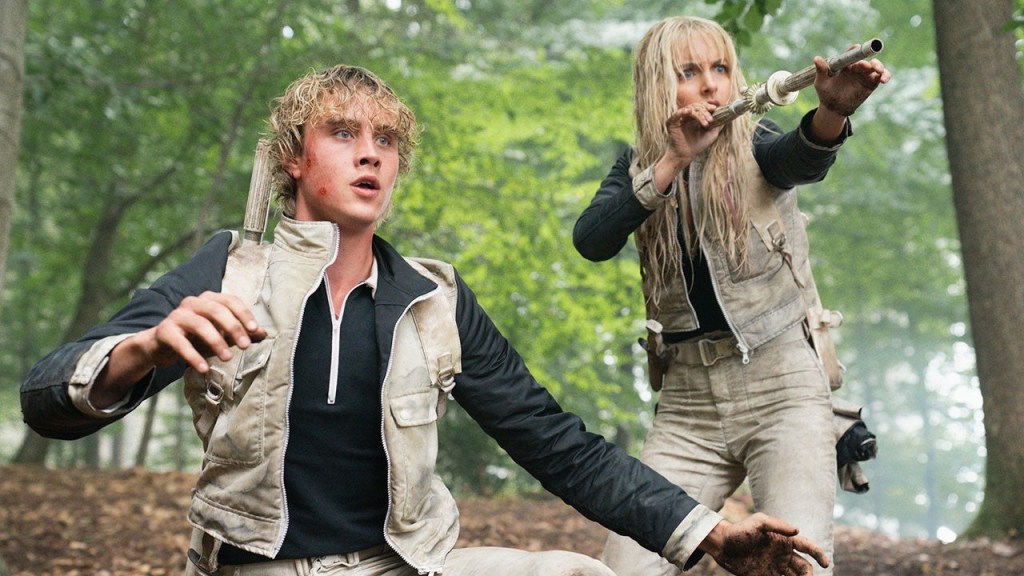
Based on Suzanne Collins’ novel of the same name and set 24 years before the first film, the story centres on the 50th Hunger Games, which also serves as the 2nd Quarter Quell. In this special edition of the tournament, each District is forced to provide twice the usual number of tributes. Among those selected from District 12 is Haymitch Abernathy (Joseph Zada), who, after meeting Capitol director Plutarch Heavensbee (Jesse Plemons) and former victor Beetee Latier (Kelvin Harrison Jr.), is encouraged to sabotage the games from within.
Clocking in at over two and a half hours, Sunrise on the Reaping is the longest instalment in the franchise so far. It’s split into three distinct chapters and, surprisingly, actually earns its runtime. Unlike its predecessor, it’s paced very well, delivering a properly developed three-act story that never loses momentum. Interestingly, the games themselves probably represent the weakest section of the film. They take place in an arena perhaps a little too similar in appearance to that from the original film and in places have a really artificial quality to them, one that cheapens the film’s overall aesthetic. Occasionally seen outside the arena too, these optics are maybe intended to represent the synthetic opulence of the Capitol, but their garish sheen doesn’t make for the most appealing of visual landscapes and certainly lacks the grit and authenticity of the earlier adventures.
Although, what it lacks in tangibility, it makes up for with its array of entertaining performances. As Drusilla Sickle, Glenn Close is the immediate standout. Literally wheeled out as the representative tasked with reaping the tributes from District 12, her completely unhinged, but immaculately crafted character design embodies all the extravagance and unpleasantness of the Capitol. Close has clearly understood the assignment too, affording Drusilla an amusing level of camp that’s undercut only by her utter evil. Every moment of screen time with her is a deranged delight. Staying with the Capitol characters, Kieran Culkin plays a young Caesar Flickerman, while Ralph Fiennes takes up the mantle of President Snow. Both are serviceable in their roles but don’t quite have the same presence as Stanley Tucci or Donald Sutherland before them. Conversely, Elle Fanning arrives like a breath of fresh air as a young Effie Trinket, complementing rather than failing in comparison to Elizabeth Banks’ original portrayal.
Of course the main focus of Sunrise on the Reaping is Haymitch. This younger version of the character is brought to life confidently by relative newcomer Joseph Zada. The Australian actor evokes Woody Harrelson’s characterisation from the first four films admirably, capturing many of Haymitch’s quirks without just doing an impression. In portraying an earlier iteration of him the film too successfully shows a side of his character that audiences may not know — surely one of the main appeals of doing a prequel in the first place.
Zada’s fellow younger cast members aren’t given as much attention though, likely down to the fact that there are 48 tributes. It would be impossible to get to know them all, but the arena scenes suffer because of it. Mckenna Grace shows great promise as fellow District 12 tribute Maysilee Donner but we don’t see enough of her. It’s since been revealed that two major scenes featuring her were cut, which seems a shame considering both their potential impact on the story and Grace’s passion for her character. Similarly, Haymitch’s girlfriend, played by Whitney Peak, doesn’t get much of a chance to establish her character as anything more than a generic love interest. Without this investment, particularly among the tributes, the stakes in the arena feel considerably lower, not helped by the fact that the majority of viewers will already know the outcome.
This matters less considering the bookends to the arena action hold the film’s secret weapon: Jesse Plemons’ Plutarch Heavensbee. Amidst all the spectacle and noise of the games, he grounds the film in its more mature political themes. Plemons brings an undeniable gravitas to Plutarch — as Philip Seymour Hoffman did before him — reminding both characters and audiences what’s really at stake. His interactions with Haymitch are electric as he tries to stoke the fires of revolution from within the Capitol while remaining undetected. Urging Haymitch to join the resistance, it’s here that the film’s real thrills lie, not the arena.
And yes, audiences know where all this is heading, but in this instance, that works firmly in the film’s favour. Serving as a potent reminder that real political change takes perseverance, sacrifice and, perhaps most crucially, time, the knowledge that it all eventually pays off gives the film’s finale a satisfaction that can only come from going back to the beginning. Sunrise on the Reaping, then, ignites a keen desire to revisit the original story and in the process proves that occasionally, prequels can have purpose.
Star Rating: ★ ★ ★



Leave a Reply