Directed by: Beth de Araújo
Written by: Beth de Araújo
Run Time: 2 hours 1 minute
The epidemic of violence against women and girls is undeniable. It’s a heinous and systemic failure of our society. Such a prevalent issue, then, should of course be reflected in our media. Ignorance simply can’t be claimed anymore, but at what age, if any, should children be educated on such things? And what happens when that decision is taken out of our hands? Brazilian-American director Beth de Araújo explores precisely this in her second feature, Josephine.
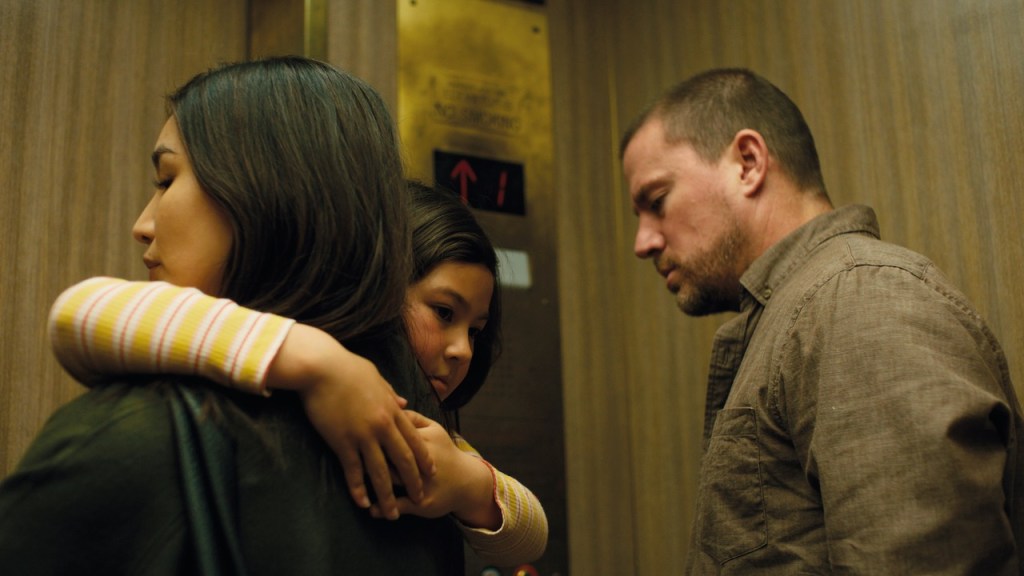
Her film follows eight-year-old Josephine (Mason Reeves) who, after becoming separated from her father Damien (Channing Tatum) in a park, witnesses a violent sexual assault. Afterwards, she begins to develop intense fear, confusion and paranoia over what she’s seen. Meanwhile, Damien and Josephine’s mother, Claire (Gemma Chan), clash over how best to parent her when she’s asked to testify against the man (Philip Ettinger) responsible for the attack.
Araújo’s film starts from Josephine’s point of view. The audience sees the world from her eyes as she gets ready to go to the park with her father. It starts as a normal daddy-daughter day, but suddenly becomes something much darker. The subsequent scene of sexual assault is incredibly graphic, arguably too graphic. It’s immediately sobering, shrouding the audience in deep discomfort. However, shouldn’t we be uncomfortable? The film is about Josephine’s loss of innocence and her changed worldview, and for audiences to really understand this, it’s important for them to see exactly what she does in the moment.
In conveying the utter atrocity of what Josephine has witnessed, the aftermath of the attack is just as effective. One device Araújo uses proves particularly chilling, creating a series of haunting images that will burrow deep under your skin. As a result, Josephine often takes on the qualities of an unbearable horror film. It’s psychologically unnerving, genuinely shocking and intensely affecting — while its foundation firmly in fact makes it all the more disturbing. It does, despite its wildly different context, have a similar atmosphere of unease to Lynne Ramsay’s We Need to Talk About Kevin (2011). Both boldly hold up a mirror to the darkest facets of human behaviour and reflect it back to their audience.
Araújo isn’t out only to unsettle her audience though, as Josephine raises many valid and vital questions about its subject matter. Namely: how is an eight-year-old ever meant to understand sexual assault? Mason Reeves captures this confusion well, both with her vacant stares and her emotional outbursts. After all, how do you explain to a child what rape is before they even understand what sex is? The film goes on to ponder these things through Josephine’s unique lens. Are all men dangerous? Is all touch bad? How can she protect herself? Unfairly, questions like these are now pressing for the eight-year-old, while her parents must too try to help her understand just exactly what has happened.
As her parents, both Channing Tatum and Gemma Chan sensitively showcase this impossible struggle. Should they shield their child from what she’s seen or should they be real and prepare her for the threat of male violence? It’s a question that parents of an eight-year-old shouldn’t have to face, and their ensuing disagreements demonstrate their understandable lack of readiness.
At first Tatum’s Damien is reluctant to be fully truthful with his daughter, naively reassuring her of her safety, even if that means omitting certain hard truths. Whereas Chan’s Claire doesn’t want to give her any false hope. There’s somewhat of a role reversal when it comes to Josephine testifying though. Likely indicative of the female experience, Claire doesn’t force Josephine to relive her ordeal, while Damien encourages her to give evidence in order for the attacker to face justice. It’s a hellish situation for them all, but Araújo’s script positions each character with a specific point of view that enriches the conversation. In depicting these differing perspectives Chan delivers some of her finest work to date, while Tatum — admittedly most celebrated for his comedic roles — reminds audiences that he’s a superb dramatic talent as well.
Ultimately, in portraying male violence against women through the eyes of a child, Josephine provokes the strongest of emotional responses, but one that should be present in all instances of such crimes. A staunch reminder that none of this should be normal or accepted, Araújo keenly observes the cruelty of this world and the systems in place to protect men, giving them every possible chance of acquittal. Her exploration of making young girls aware and prepared for this threat doesn’t provide any conclusive solutions, which is perhaps the point. It isn’t the girls or women that need educating, it’s the boys and men.
Star Rating: ★ ★ ★ ★




Leave a Reply