Directed by: Travis Knight
Written by: Chris Butler
Run Time: 2 hours 11 minutes
Compared to other forms of animation, stop-motion doesn’t get the attention it deserves. While films of this medium often become critical darlings, they seldom result in big box office. Aardman, arguably the most successful stop-motion studio, does have a substantial fanbase in the UK, but overseas their films just aren’t as beloved, and when it comes to the second-biggest studio, Laika, their only real runaway success has been their debut, Coraline (2009).
This hasn’t stopped Laika from releasing another four feature films though, all of which are unique, delightful and Academy Award-nominated. Their new feature Wildwood, based on Colin Meloy and Carson Ellis’ illustrated dark fantasy novel, looks set to continue this trend — and with hundreds of sets and character puppets used to bring this world to life, it’s Laika’s most ambitious film yet.
Closely following the plot of the novel, the film introduces audiences to Prue McKeel (Peyton Elizabeth Lee), a young teen coming of age in Portland, Oregon who lives with her parents and infant brother Mac. One day while she’s looking after him, Mac is kidnapped by crows and taken into the Impassable Wilderness, a shadowy woodland over a bridge which engulfs a fantasy world. Together with her classmate Curtis (Jacob Tremblay), she embarks on a quest to save her brother from the rogue Dowager Governess, Alexandra (Carey Mulligan).
After focusing on live-action blockbuster filmmaking following his debut feature, Kubo and the Two Strings (2016), director Travis Knight (also the co-founder and CEO of Laika) has returned to the world of stop-motion with Wildwood — and, wonderfully, it’s his best film yet. Using the impressive world building already established by the source material and his expertise as a visual storyteller, he’s crafted something so distinctly Laika. With the studio’s past acclaim, it may seem redundant to discuss the film’s animation, but even with their polished portfolio considered, it truly is an astonishing achievement.
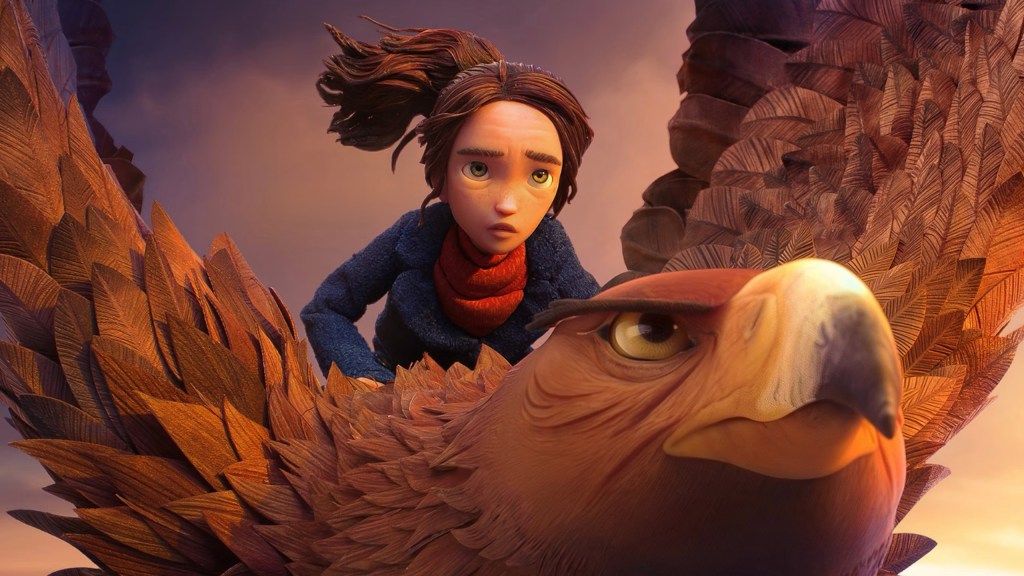
The level of ambition in the craftsmanship and scale is unlike anything else ever seen in stop-motion before, with such precision and detail used to make every landscape, prop and building feel fully integrated into the film’s world and look convincingly to scale too. Each of the character designs are beautifully realised as well, in particular that of the General (Angela Bassett), a giant eagle who acts as Prue’s guide through the titular Wildwood. Each of her feathers are designed to evoke the look of autumn leaves, allowing her to gorgeously complement the forests she’s found flying over.
Adding to these character and set designs is an impressive cast, all of whom do an excellent job at creating unique voices. Peyton Elizabeth Lee delivers a wonderful and confident performance as the protagonist. While a lot of her interactions involve exposition from others, this never come at the expense of the film’s pacing, and Prue’s personality still shines through as a precocious teenager who, while inexperienced, remains very caring and determined.
Every supporting member is just as good; often with an ensemble consisting of so many big names, it’s easy for star power to overshadow character, but thankfully Wildwood does not fall into this trap. Mahershala Ali does especially well as the leader of the bandits. While even those playing talking animals such as Charlie Day and Awkwafina, two actors often criticised for giving the same performance repeatedly (especially in voice roles), do great work of creating personalities to the point where they’re barely recognisable.
However, it’s Carey Mulligan, in her first ever animated film role, who might just give the best performance. Alexandra is a character who is so obviously the film’s antagonist, but she has a past which draws an interesting parallel to Prue’s plight and Mulligan is tragic enough for us to feel a level of sympathy towards her, in the way that all the best villains do.
A small part of said backstory is set up as the film’s opening scene. It features some rather striking and upsetting imagery and establishes Wildwood’s biggest positive: remarkably, it refuses to sanitise the story’s more mature elements. Laika has never been afraid to embrace dark themes and concepts, but being their first film with a 12A/PG-13 rating, it’s clearly not looking to appeal to young children. Violence is shown on screen, blood is shed, both humans and animals die, and even the child characters are very frequently under threat.
This could potentially put off some of its already niche audience, but gratefully it’s not a dour, depressing watch, and actually has a lot of comedy throughout. Occasionally it doesn’t land (one joke is lifted directly from Hot Fuzz) but thankfully it’s never used at the expense of emotional or serious moments.
As a matter of fact, and in an astonishing new peak for the potential of stop-motion, a climactic battle sequence manages to play out with a similar level of intensity to a Middle Earth movie. Even divorced from the context of how it was made, the scale is incredibly impressive. But with the knowledge that almost everything on screen was created using puppets and miniatures (some small CGI touch-ups are also used), it’s hard not to be left wondering just how the crew were able to accomplish such an ambitious and gargantuan feat.
Such achievements in filmmaking are often accompanied by the debate of whether they should be praised more for technical prowess or emotional impact, but Wildwood excels at both. Even the film’s end credits are a joy to sit through, offering audiences a compilation of concept art and illustrations in the style of the source novel. In an inspired choice, the final image in the credits is of a short timelapse of how one shot was made, cleverly leaving viewers with a vivid idea of just how much work went into creating this magical story.
One, that with its themes of grief, growing up and finding beauty in nature, accomplishes the increasingly rare achievement of being an animated film with universal appeal. Therefore, irrespective of age, it’s difficult to imagine anyone leaving the cinema after watching Wildwood and not feeling utterly awestruck.
Star Rating: ★ ★ ★ ★ ★



Leave a Reply