Directed by: Josef Kubota Wladyka
Written by: Josef Kubota Wladyka and Nicholas Huynh
Run Time: 2 hours 2 minutes
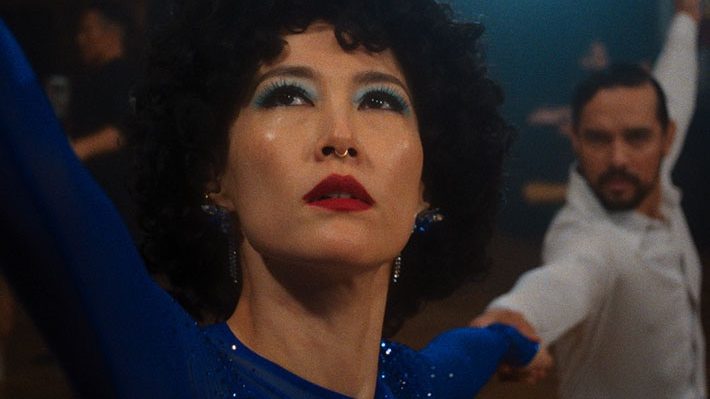
After her breakthrough role in Alejandro González Iñárritu’s critically acclaimed Babel (2006), Rinko Kikuchi became only the second ever Japanese actress to be nominated for an Academy Award — and there’s still yet to be another. Since then her career has spanned many genres, but she’s perhaps best known for playing Mako in Pacific Rim (2013). Her latest film, Ha-Chan, Shake Your Booty!, however, sees her swap kaiju for quicksteps, as she struts her stuff as a competitive ballroom dancer in Josef Kubota Wladyka’s new drama.
The film follows Haru (Rinko Kikuchi) and her husband Luis (Alejandro Edda) who are keen competitors in the Tokyo ballroom and Latin scene. While participating in their latest competition Luis suddenly collapses and sadly passes away from a heart attack, leaving Haru completely devastated. She withdraws from her friends and family and stops dancing altogether. Nine months later her sister Yuki (Yoh Yoshida) and friend Hiromi (You) encourage her to take to the floor again, and after reluctantly returning to the studio she meets a new instructor, Fedir (Alberto Guerra), and quickly begins to develop feelings for him.
With a title like Ha-Chan, Shake Your Booty! and an opening that sees its titular character (Ha-Chan is Haru’s nickname) joyfully dancing around her house, this doesn’t, at first, necessarily seem like a film about grief. There’s certainly a striking juxtaposition between the glitz and glamour of the ballroom and the despair and misery of bereavement, aptly so too. As when the film shifts into this darker phase of its narrative the clear disparity helps to emphasise the magnitude of Haru’s loss. Yet the film refuses to wallow in this same heaviness, instead exploring her grief through humour, romance and, of course, dance.
Often, the dance sequences make perfect sense, taking place in a studio or on a dance floor. But, just like the fun and whimsy of a musical, any scenario can become something more theatrical, and here Wladyka takes great advantage of this. A physical altercation between Fedir and a stranger becomes an elaborate dance number, while a theatre performance offers a more immersive experience for Haru as she goes from audience member to starring role. These moments are always a delight and provide the picture with a real flourish of fancy. Shot with skill and precision, and performed with such quaint charm, it’s almost bittersweet when each comes to a close. If the film could have been entirely danced, Ha-Chan, Shake Your Booty! would only have benefited.
At times, it’s so much fun that it’s easy to forget that this is a film firmly rooted in grief. What it has to say on the matter isn’t groundbreaking, but its approach to delivering this message at least feels somewhat unique. Haru’s grief manifests in the form of a large, looming black bird, often seen lurking in the corners of her home. Yet it’s quite clearly (and comically) an actor in a big, fluffy costume. The duality of this device — both a large, inescapable presence that often prompts feelings of guilt when Haru experiences a rare moment of happiness, and an unusual source of comfort that can be physically embraced — captures the confusing, all-encompassing hold that grief takes on us. This imagery is more effective than the film’s eventual suggestion that grief is something that needs to be let go of, but its simple observations and comparison to dance about living in the present ultimately still ring true.
Although its journey to arrive at this point isn’t just signposted by its depiction of grief and its dazzling dance numbers, but by its comedy too. Both Wladyka and writing partner, Nicholas Huynh, infuse the screenplay with playful humour that affords the subject matter a welcome levity. This, along with its six-chapter structure, helps to manage the pace of the film’s two-hour runtime. However, the film’s length will be of little concern to audiences as they enjoy the visual gags, elaborate set-pieces and amusing character dialogue found throughout.
Much of this comedy comes from the love triangle that Haru has to navigate in her own head. As her feelings for Fedir intensify, so too do her memories of her late husband, Luis, and matters are only further complicated by Fedir’s open relationship — or, more accurately, Haru’s reaction to it. This allows the film to address another aspect of grief, namely its ability to make us do things we would never normally do. They say it takes two to tango, but with Haru torn between past and present partners, a dance-floor disaster is sure to ensue. Rinko Kikuchi conveys this chaotic choreography with ease, excelling in both the comedic and dramatic nuances of her performance. Meanwhile, Alejandro Edda and Alberto Guerra both comfortably fit the bill as romantic interests, and like the disco ball spinning above the dance floor, will leave viewers suitably starry-eyed.
There’s no denying, then, that Ha-Chan, Shake Your Booty! is a proper high-flying production. It’s potentially even a little too overambitious, considering the more straightforward take it settles on. There’s still value to be found, though, and viewers who take the film’s advice to be present in each moment are offered the chance to feel Haru’s experience and connect it to their own. And sure, some extra razzle-dazzle never hurt anyone — it might even be what saves us.
Star Rating: ★ ★ ★






Leave a Reply