Directed by: Alex Huston Fischer and Eleanor Wilson
Written by: Alex Huston Fischer and Eleanor Wilson
Run Time: 1 hour 46 minutes
Declaring that Alexander Skarsgård has range is no great revelation. He’s already played a centuries-old vampire in True Blood, a viking prince in Robert Eggers’ The Northman (2022) and even a BDSM biker in Harry Lighton’s Pillion (2025). Not content to rest on his laurels, however, his latest part in Alex Huston Fischer and Eleanor Wilson’s Wicker sees him extend this remarkable repertoire to, well, rattan? Yes, that’s right, he can now add the role of ‘Wicker Husband’ to his résumé — an idiosyncratic flex if ever there was one, even for him.
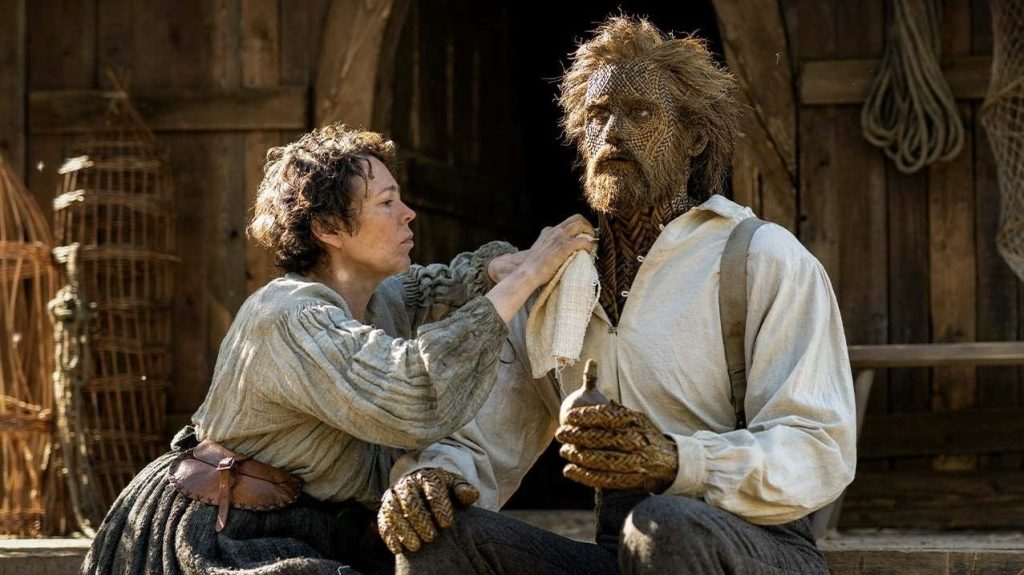
The film follows a fisherwoman (Olivia Colman) who spends her days catching produce to sell at the local market of her rural medieval village. Despite her daily contribution to her community, she’s commonly shunned for her fishy odour and status as a single woman. Later, during a playful ritual at a village wedding, it’s suggested that she could be the next to get married. However, after this idea is met with mean-spirited laughter and general disbelief she asks the local basket weaver (Peter Dinklage) to make her a husband. One month later, she meets her wicker groom (Alexander Skarsgård) at the altar and the pair are wed.
Wicker might sound like a fairytale, but its absurd premise and more mature content distance it from the likes of DreamWorks and Disney. An early scene where the fisherwoman flogs her fish at the market feels like a twisted, more unkind version of Belle’s village jaunt in Beauty and the Beast (1991). As rather than songs about her attractiveness or admirers vying for her affection, the fisherwoman is met with cruel jibes and nasty insults. Although, undeterred by such vitriol, it’s here that Wicker first establishes the fisherwoman’s resilient character, before later, really putting it to the test.
Of course, Olivia Colman is fantastic at portraying this feisty, foul-mouthed fisherwoman — but she’s only giving as good as she gets. Bemused by the constraints of traditional matrimony, when she herself gets hitched to Alexander Skarsgård’s wicker husband, their more modern marriage starts to seriously ruffle some feathers. Wicker is a naturally funny film, with humour woven throughout the screenplay, but it’s the villagers’ unhinged reactions to the fisherwoman’s new marital bliss that help it to become really hilarious. That, and one particularly hysterical scene featuring the most chaotic of cameos.
Just as its comedy is carefully constructed, so too is the intricate costume design that transforms Skarsgård into this basket beefcake. The craft employed to create such a crucial part of the film is perhaps its most impressive aspect. Using almost entirely practical effects, including prosthetics and innovative 3D printing techniques, New Zealand special effects house, Wētā Workshop have ensured their work is wholly convincing while still leaving the actor underneath the freedom to perform. Skarsgård feels like the perfect fit for the role too, affording the wicker husband an innocence and an appeal that sells his allure to both the fisherwoman and the lustful eyes of her fellow villagers.
This amusing array of supporting characters actually carries most of the film’s commentary on tradition and relationships too. Most prominently so is Elizabeth Debicki, who plays the wife of the town tailor and has asserted herself as the head of the social hierarchy. Threatened by the fisherwoman’s sudden sense of agency and unwillingness to accept her predetermined fate, she doubles down on her one-sided rivalry with her. Debicki captures this dismay expertly, enlivening a character that’s just about as rotted as they come, while Colman’s comedic and cutting comebacks only add further fuel to her fire. Every fairytale needs a good villain, and Debicki delivers this, with wickedness in spades.
So there’s villainy, romance and fantasy, but what’s this curious fable’s moral? Well, its sharpest perception is in its ridicule of tradition. Why must romantic rituals and outdated gender roles be so rigidly observed? The wicker husband challenges the village’s deeply entrenched conventions, and while the resident’s covet his well-endowed weaving and surprising emotional attentiveness, they’re still reluctant to embrace what he represents, or at least allow the fisherwoman to. He stays at home, while she works; he deals with domestic duties without dispute; and novelly, he can actually satisfy his wife sexually — more than can be said for the village’s more mediocre menfolk. Wicker suggests then, that marital traditions, without romance serve no real purpose.
And while the film rightfully celebrates the fisherwoman’s autonomy, what about the wicker husband’s? If he’s been created for the sole function of marrying the fisherwoman, does he have agency as well? Thankfully, the film does at least address this, but just like the mould that sporadically appears amidst the grooves of his woven body, Wicker isn’t without a few imperfections of its own.
A climatic teaching moment motivated by revenge for the heinous treatment of the newlyweds is more prickly than possibly first planned. While obviously intended to punish the townspeople, doing so at the expense of another innocent feels counterintuitive to the film’s message. Originating from the undercooked development of Peter Dinklage’s basket weaver — played like a more fanciful Dr. Frankenstein — his character isn’t explored in enough detail to assess the ethics of his involvement in the creation of these sentient souls.
Raising just as many questions as it answers, then, this is a fable that’s perhaps best not overthought. But frankly, when it’s as wildly entertaining as it is, it’s really not too much of an ask. With all the wonder of a man made of weaving, and the ample whimsy of him representing dream husband material, Wicker remains an absolute rattan riot — splinters and all.
Star Rating: ★ ★ ★ ★




Leave a Reply