Directed by: Simon Stone
Written by: Stephen Beresford
Run Time: 1 hour 51 minutes
While everyone might not have seen Hugh Hudson’s Best Picture-winning Chariots of Fire (1981), most will at least be familiar with its score, particularly the iconic title theme by composer Vangelis. It’s what the film is best known for and a good example of how success can sometimes be measured simply by what’s most memorable. It’s a sentiment that Ian Charleson, the actor and star of the film, knew all too well, and one that new drama Elsinore also explores.
Directed by Simon Stone, the film observes Charleson (Andrew Scott) in the years after the release of Chariots of Fire. Struggling to escape his increasingly irksome association with the film, his career loses momentum and he later discovers that he has AIDS. Soon after, director Richard Eyre (Johnny Flynn) offers him his dream role of playing Hamlet in a National Theatre production. Despite his health and the advice of Dr Margaret Johnson (Olivia Colman) he takes on the role while trying to keep his illness hidden from his co-stars.
Clearly, Shakespeare’s Hamlet continues to be a source of great inspiration for contemporary storytelling. Greg Kwedar’s Sing Sing (2023), and more recently, Chloé Zhao’s Hamnet (2025) both directly reference the work, while Aneil Karia’s Hamlet (2025) and meta-documentary Grand Theft Hamlet (2024) offer more unique re-imaginings of the classic play. What is it, then, that sees writers and directors return to its prose and verse so often? Its themes of morality certainly hold a universal appeal and, in the case of Elsinore, have a sombre relevance to Charleson’s own health struggles. The film doesn’t shy away from the parallels either, with Charleson even acknowledging the cosmic irony of it all. The correlation is so obvious that the film is wise to embrace it so willingly.
Yet, even with its heavy subject matter, Elsinore often offers its audience an unexpected levity. This is especially true in the film’s first act, which opens with a certain acclaimed actor dramatically storming out of Hamlet mid-performance, making way for Charleson to tread the boards instead. Elsewhere, there’s comedy to be found in simple storytelling between Charleson and his queer contemporaries. Gays just know how to spin a good yarn, and its these candid anecdotes and catty comments that will bring the biggest smiles to viewers’ faces, but also, bittersweetly, a sadness knowing all that has, and will be lost.
Still, there’s joy to be found in the film’s supporting cast too. A drawl and sarcastic Monica Dolan stars as Linda Tolhurst, the theatre’s well-established stage-door supervisor. Not shy of keeping Charleson’s ego in check, Dolan’s unimpressed demeanour and expert line delivery make for much comedy, while her genuine care creates several special moments between the pair. Alongside her, Billie Piper plays Charleson’s brash bestie and casting director Patsy Pollock. She brings great bravado to the screen, all the while embodying a deep and tender friendship that shows the unmistakable bond between a girl and her gay best friend. Completing the film’s superb trio of female performances is Olivia Colman as Dr Margaret Johnson. She’s a formidable, no-nonsense professional, but Colman affords her an increasing warmth as she grows ever fonder of her patients. Elsinore would be lucky to boast even just one of these actors, so to have all three amongst its cast feels almost bad-mannered.
Of course, a film depicting AIDS will inevitably carry an emotional weight, and here a mournful mood can be felt throughout — often in tandem with the film’s lighter moments. While the focus is Charleson’s experience, Elsinore extends its reach, exploring the epidemic’s wider impact and the varying reactions to it. As you might expect, it’s a consistently heartbreaking watch. Showing the illness at different stages, the film depicts a community struck down, but also one pulling together. It captures the beautiful camaraderie between these men in real, tangible ways. The recommendation of the best doctor they know, the reassurance of an earnest hug or simply the clinging on to a friend in their hospital bed. Sitting with this discomfort and sorrow reminds audiences of the devastation, but also the profound affection of a generation so cruelly afflicted.
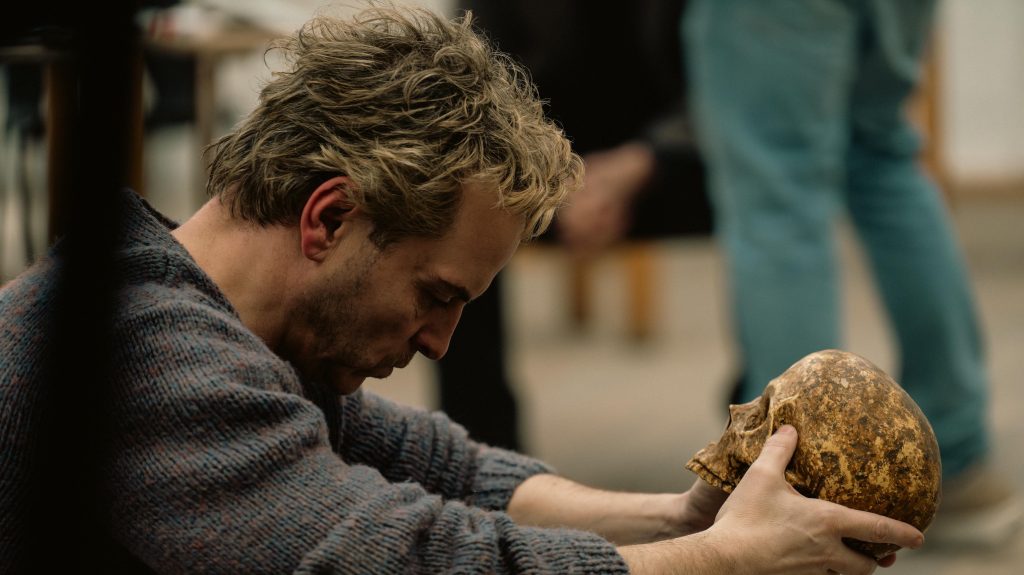
And as Ian Charleson, Andrew Scott is magnificent. Perhaps his most commanding performance yet. He feels so deeply settled in the role, conveying the anguish of a life cut short and dreams not realised, but also the courage to go after them anyway. The film documents Charleson’s fears of National Theatre audiences seeing him rather than Hamlet on stage — one of the reasons he was reluctant to disclose his diagnosis. Well, Scott may relinquish any similar notions, as viewers will see only Charleson here. Selling the emotion scene after scene, his piercing blue eyes cutting right through the screen, Scott will have audiences in the palm of his hand, just as Hamlet has the skull of Yorick in his.
Eventually, and much like the aforementioned Sing Sing and Hamnet, Elsinore builds to a predictably emotive finale. Some will say that it’s too sentimental, mawkish even, but for those invested in Charleson’s story — and it would take a pretty cold heart not to be — it offers a jubilant catharsis. To be, or not to be? That is the age-old question. Well, Elsinore answers it rather assuredly.
Star Rating: ★ ★ ★ ★





Leave a Reply