Directed by: Danny Turkiewicz
Written by: Danny Turkiewicz
Run Time: 1 hour 18 minutes
Quentin Tarantino’s Pulp Fiction (1994) is widely considered one of the greatest films of all time and the director’s own personal masterpiece. It’s unsurprising then that it’s also a firm favourite of the film bros – and they’ll certainly not let you forget it. Really then, it was only a matter of time until one of these steadfast fans decided to demonstrate their deep love for the crime classic by making an entire film devoted to it. Enter Danny Turkiewicz and his heist-comedy homage, Stealing Pulp Fiction.
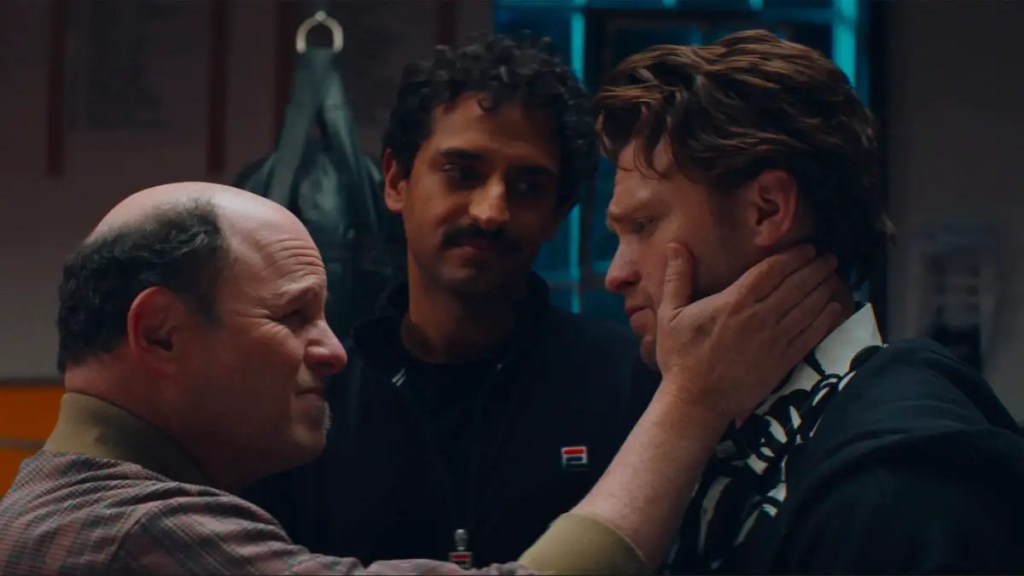
Based on his 2020 short film of the same name, Stealing Pulp Fiction follows a bunch of friends who hatch a plan to steal Tarantino’s personal 35mm print of Pulp Fiction during a special midnight screening at his movie theatre. The group consists of cinephiles and best friends Jonathan (Jon Rudnitsky) and Steve (Karon Soni), self-confessed Tarantino hater Elizabeth (Cazzie David), and down-and-out therapist Dr. Mendelbaum (Jason Alexander).
Between the film’s division into chapters, its many diner-set sequences and Jonathan and Steve’s own impassioned opinions about the film, Turkiewicz’s love for Pulp Fiction shines through. Thankfully, he isn’t opposed to entertaining the idea of having some healthy criticism levelled against it too though. This comes courtesy of Cazzie David’s wonderfully cutting Elizabeth who is not a fan, taking issue with the director’s misogyny among several other of his more infamous associations. Elizabeth brings about a welcome change of pace from the over-enthusiastic and rather one-note Pulp Fiction circle jerk already occurring, and in doing so offers an entry point for those who maybe aren’t just quite as taken with the Tarantino classic as most.
While this quickly demonstrates that Turkiewicz is comfortable welcoming some jibes at the classic he so clearly cherishes, ultimately he’s not as good at making jokes as he is at taking them. The idea of a bunch of film nerds stealing a rare print of a famous film is a lot of fun, but by way of his awkward and mostly unfunny dialogue-driven script, this rarely translates onto screen. The words of Uma Therman’s Mia Wallace come to mind: “Don’t you hate that?…Uncomfortable silences.”
Perhaps it’s the fact that his characters have no actual motive? As even for something as nonsensical as Stealing Pulp Fiction there needs to be some semblance of believability to the characters’ actions. Maybe this would have worked better with a group of immature film students, or a trio of disgruntled teen movie fans denied entry to the R-rated screening, because with the lack of humour or any hint of plausibility the premise becomes disinteresting an at increasingly rapid rate.
That’s not to say that the cast aren’t trying. In fact, they all give suitably spirited performances. Jon Rudnitsky is a fun leader of the pack, with Karan Soni perfectly placed to provide the comic relief. Cazzie David’s cynicism undercuts the two, while Seinfeld‘s Jason Alexander offers an additional, more unhinged personality to complete the group. They are all adequately positioned in order to make the dynamic work. Turkiewicz just doesn’t give them the material they need to succeed – however, that is with the exception of one other cast member. Seager Tennis, who makes an appearance late on, brings with him all of the film’s funny. The identity of his character is best left unknown, but rest assured that his arrival finally sees the film deliver on the comedic potential of its madcap plot.
Unfortunately, this late comedic addition isn’t enough alone to make Stealing Pulp Fiction worthwhile as a whole. In-between Tennis’ sporadic screen time audiences are left for far too long enduring Turkiewicz’s tiresome attempts at Tarantino-esque dialogue, making the minuscule runtime (78 minutes) feel like some of Tarantino’s very longest. Coupled with other filmmaking inexperiences such as its poor sound mixing that sees the score often drown out the dialogue, the wheels fall off this particular heist vehicle faster than that in Reservoir Dogs (1992).
However, maybe to some its imperfections and low-budget feel will be its charm. There’s certainly plenty of potential for future double feature programming alongside the original film. But its very association with Pulp Fiction is both its biggest selling point, and also – by failing in comparison – where it completely comes undone. Turkiewicz’s dancing will need to be a lot better if he really wants that trophy.
Star Rating: ★ ★





Leave a comment