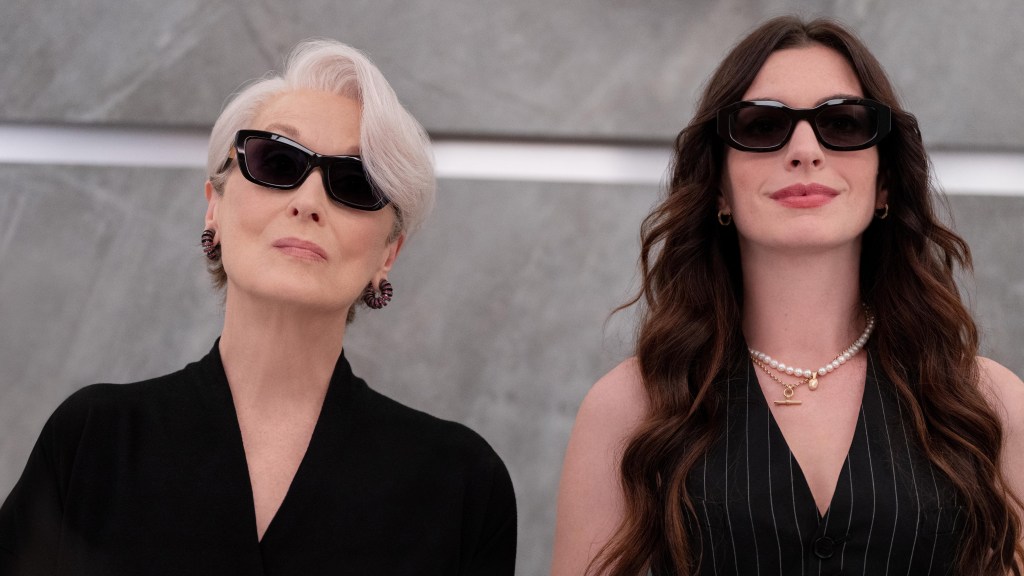
Directed by: David Frankel
Written by: Aline Brosh McKenna
Run Time: 1 hour 59 minutes
“Iconic” has become a word thrown around far too flippantly. Used as a label to instantly attach to anything even slightly above average, it’s lost much of its impact. Although, when it comes to David Frankel’s much-loved comedy-drama The Devil Wears Prada (2006), it couldn’t be more fitting. Between Meryl Streep’s Oscar-nominated performance as the formidable Miranda Priestly, the film’s archive of indelible quotes and a legacy that now includes a successful West End musical, its icon status is impossible to deny. Perhaps then, a sequel, The Devil Wears Prada 2, was always inevitable. But with such impressive designer shoes to fill, could it ever reach the same level of cinematic couture?
Set twenty years after the original film, Andy Sachs (Anne Hathaway) is now a successful and respected New York reporter. However, after her whole team are abruptly let go during an awards dinner, suddenly she finds herself without work. Meanwhile, Runway magazine has become the centre of a major scandal after unknowingly promoting a brand linked to sweatshop labour, triggering a major media backlash. In a bid to repair its image, the publication recruits Andy as its new features editor — but without the knowledge or approval of her former boss and Runway editor-in-chief, Miranda Priestly (Meryl Streep).
Being the latest to partake in the now well-established trend of the legacy sequel, Frankel’s follow-up has aptly updated itself to align with the world of modern-day publishing. Two decades on and Runway has now gone fully digital with Miranda’s once monocratic management of the magazine now feeling far more measured. Yet, in succumbing to the realities of the real world and recognising the constraints of human resources, this sequel immediately loses much of the charm it was set to inherit from its predecessor. While evidently realising that The Devil Wears Prada just couldn’t be made today, Frankel and returning screenwriter Aline Brosh McKenna have failed to offer an alternative capable of matching the original’s exciting glimpse into the world of glossy magazine making or the fun that went along with it.
Really, this sequel simply shouldn’t exist. These characters and setting can’t operate in the way they used to, so they’ve had to adapt, and frankly, the change is depressing. Most disappointing is the writing for Miranda, which sees her character become a shadow of her former self. Of course characters are allowed to change, but when you have one as imposing as Miranda Priestly — the cold beating heart of the first film — reduced to a yes-woman, willing to go along with important negotiations without input, flying economy class, and even having to hang up her own coat, you have to ask exactly what we’re doing here. Explanations for these uncharacteristic actions do come, but none satisfying enough to warrant such poor treatment of the title character.
It’s an overcrowded ensemble too, as alongside its star-studded main quartet, there is a new collection of names fresh to the franchise. Simone Ashley, Caleb Hearon, and Helen J. Shen play various assistants who make little to no impact, while Kenneth Branagh and Patrick Brammall play the bland love interests of Miranda and Andy. With so many characters in play, there is a collective dilution of the film’s substance, one that can’t even be saved by a Lady Gaga cameo. Still, hearing her and Doechii’s original song Runway blasted through surround speakers is one of the few reasons to see the film at the cinema.
The only other time the sequel properly finds its groove is during an early sequence that sees the four main characters reunited. In the wake of their publishing mishap, Miranda, Andy and Nigel (Stanley Tucci) visit one of their most important advertisers, Dior. It’s here that Emily (Emily Blunt) makes her scene-stealing entrance, announcing herself as the film’s greatest asset and perhaps even soft launching a spin-off of her own? An idea that certainly would have been preferable to simply stringing together the offcuts of the original into this patchwork piece that pales in comparison. The same mirror-wipe opening, another Vogue montage and a European city for the third act? Groundbreaking.
For all of these familiar beats, it does at least attempt to engage with a more serious commentary on journalism too. It shines a spotlight on how clicks, rather than quality, have become today’s most valued media currency, while also criticising how parent companies are bought and sold on whims as playthings for the mega-rich. While astute in its observations, it doesn’t deliver them with enough flair, finesse or depth, presenting a collection of business meetings that range from dull to silly, rather than focusing on the fabulous fashion and elegance of its elusive high-end industry.
At least returning costume designer Molly Rogers delivers a wardrobe that largely feels modern, chic and expensive, somewhat making up for the fashion-lite screenplay. That is, with the exception of Miranda’s garish tasselled jacket, which feels like yet another misunderstanding of not just her character, but her style. Then again, the film doesn’t have any of its own. Instead, it’s paraded around like a designer knock-off. At first glance it might look like the real thing, and it will likely fool those willing to overlook the finer details, but no matter what it achieves in cheap imitation, it will never be a true original of its own.
That’s all.
Star Rating: ★ ★



Leave a comment