Directed by: Danny Boyle
Written by: Alex Garland
Run Time: 1 hour 55 minutes
Making a great movie trailer has all but become a lost art. Yet, occasionally one will come along that is so captivating it warrants the same, or an even greater level of reverence than the film it’s promoting. The thrilling teaser trailer for The Girl With the Dragon Tattoo (2011), which delivered on its promise of being “the feel bad movie of christmas” is one of the most memorable examples of this. While more recently the trailer for 28 Years Later has too achieved this same, rare level of acclaim.
The use of Taylor Holmes’ chilling rendition of ‘Boots’ – Rudyard Kipling’s 1903 poem about soldiers marching into war – alongside the film’s disturbing images offers an especially intense preview of the horrors to come. Aside from Holmes’ haunting reading, the trailer uses minimal dialogue and in doing so skilfully creates an atmosphere rather than just a synopsis, one that demands attention in an unshakable manner. It does a tremendous job of generating hype without revealing too much of the plot. However, the problem with releasing such an effective and exciting trailer is that the film then has far greater expectations thrust upon it.
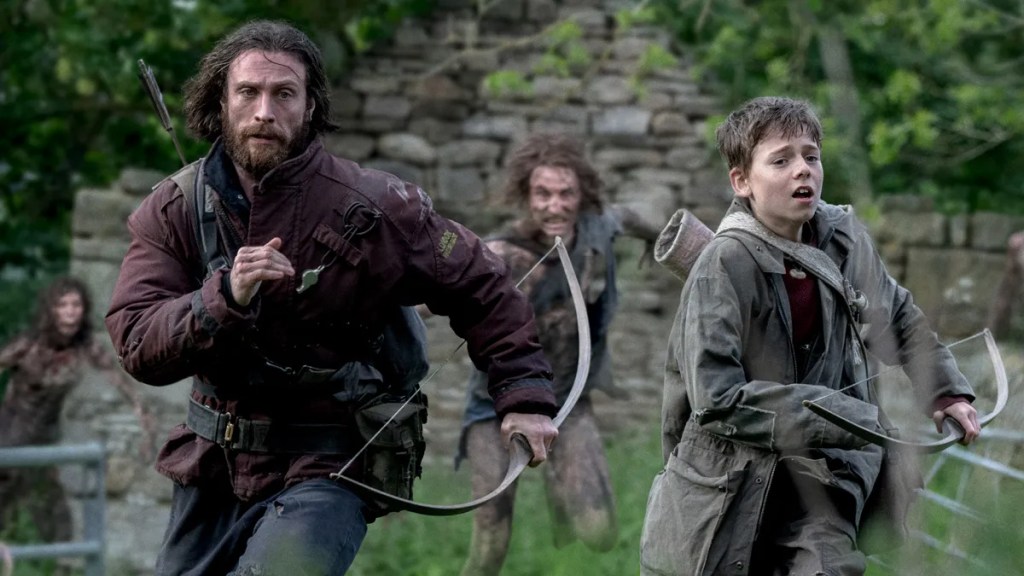
Attempting to meet these is director Danny Boyle and writer Alex Garland, who return to the franchise creatively for the first time since the original film in 2002. Their sequel is set, as the title would suggest, almost three decades after the initial outbreak of the Rage virus. With the UK now existing under strict quarantine, only pockets of survivors remain. Amongst them are an island community who reside apart from the mainland, connected only by a single, protected causeway. When one of the island’s residents, Jamie (Aaron Taylor-Johnson) takes his son Spike (Alfie Williams) to the mainland, he inadvertently unlocks a cynicism in him that makes him start to doubt everything that he’s been taught.
28 Years Later unfolds as a film of two halves, each of which is thematically rich enough to be a feature of its own. But before they get underway, first the prologue depicts the brutal zombie attack shown in the trailer. While a room full of children watch the Teletubbies, the infected burst in and a savage onslaught ensues. It’s a striking juxtaposition of youth and innocence with blood and violence that has all the potential to be one of the series’ standout sequences. However, it’s rushed through without allowing for a proper build of tension making for a somewhat underwhelming first impression.
When its predecessor, 28 Weeks Later (2007), boasts one of the best ever horror openings, this by comparison feels a little lacklustre. Yet even within these brief opening moments Scottish hip-hop trio Young Fathers, who provide the film’s soundtrack, are able to engage their new cinematic audience with much aplomb. Their track ‘Promised Land’ accompanies the vicious zombie rampage and the piece’s religious connotations accent the biblical themes of the dialogue perfectly. It’s a shame this section doesn’t have that bit longer to breathe, as with such an engrossing sound this could have become an all-timer opening.
As the action moves to the island, 28 Years Later finds a firmer footing. It’s here where audiences are introduced to the surviving members of society, and their new way of life – which surprisingly isn’t far from how it was before. Garland’s script immediately takes aim at the misplaced sense of nationalism the residents have retained, despite having the chance to start over fresh. There’s an English flag flying high, a portrait of Queen Elizabeth II hangs in the town hall and in the classroom the children are taught to sing ‘Abide With Me.’
What’s more alarming is the normalisation of sending 12-year-old Spike to the infected-ridden mainland as part of a culturally accepted and celebrated rite of passage. The only person who seems to object is his sick mother, Isla (Jodie Comer) insisting he go to school instead. Like the trailer, the film goes on to utilise Kipling’s ‘Boots’ as Jamie and Spike venture to the mainland in one of the film’s most effective scenes. As Jamie marches his son into battle, the film uses other footage and of course the haunting words of Kipling’s poem to reflect upon the tragic sacrifice of Jamie’s boyhood and many of the soldiers and young men before him.
As Spike is exposed to the horrors of the mainland – expertly captured by Boyle’s inventive cinematography, albeit at times hampered by overindulgent editing and unconvincing VFX – he too gains enlightenment about the world he’s been raised in. The first half sees him forced into violence by his father, whereas in the second he witnesses the same landscape but through the lens of the love and compassion that his mother so naturally emanates for him.
This shift brings with it a powerful wave of emotion that crashes down upon unwitting audiences who were likely expecting nothing more than a violent zombie flick. In a genre piece like this, favouring such earnest sentiment in crucial moments is brave, but with such a talented cast in place to ensure it’s carried off successfully, it makes complete sense.
It’s difficult to pick a standout when each member of the core ensemble is so good. Jodie Comer delivers a devastating performance as Isla, Spike’s mother. She demonstrates the strength of Isla’s maternal instincts in protecting Spike, despite the increasing difficulties of her illness. While as the other half of this mother-son dynamic Alfie Williams is similarly superb. It’s hard to believe this is only his first leading role considering he balances the screenplay’s intense combination of themes with such effortless ability. His performance alone gives the plot of the second half legitimacy, showcasing that a son’s love for his mother is reason enough to explain any and all actions, no matter how reckless them may seem.
Elsewhere, Aaron Taylor-Johnson as Jamie and Ralph Fiennes as Dr. Ian Kelson both impress, acting as two very different examples of male influence for Spike. Fiennes in particular creates an outlet for the emotional catharsis that the film so beautifully builds too, once again bolstered by Young Fathers’ stellar soundscape. As amongst all the film’s blood, guts and gore its meditation on the relationship between love and death is what will stain the hearts of its audience most deeply.
It’s perhaps somewhat of a surprise then, that after such a moving climax, the film chooses to leave viewers with such a jarring moment of shock and confusion in its very final moments. A divisive ending it will be for sure, but it demonstrates both Boyle and Garland’s commitment to exploring a uniquely British post-apocalyptic landscape. And frankly, what could be more terrifying?
Star Rating: ★ ★ ★ ★

 Not Too Loud
Leave a reply to REVIEW: 28 Years Later: The Bone Temple – Ralph Fiennes rocks in violent but versatile horror sequel – Not Too Loud Cancel reply