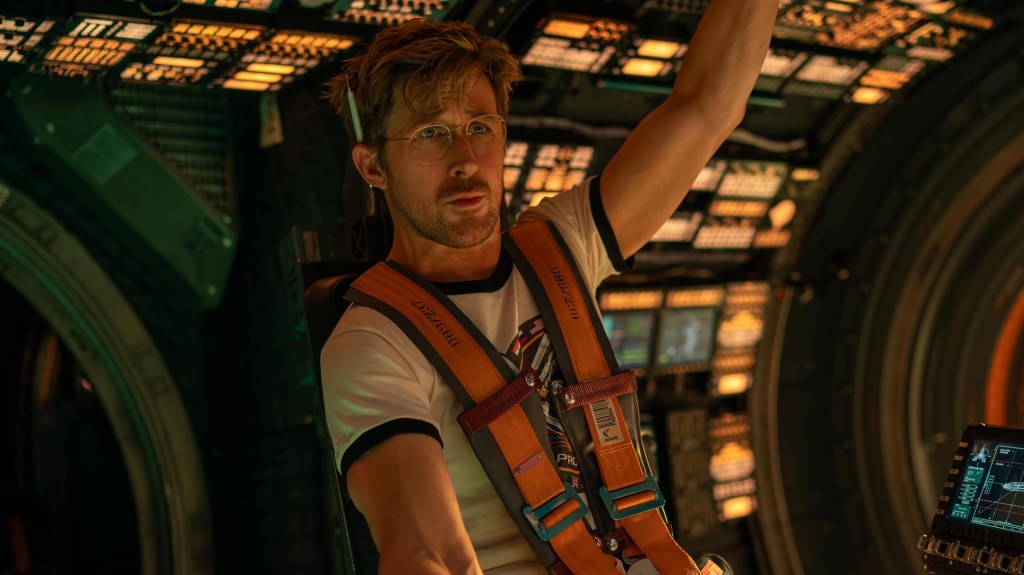
Directed by: Phil Lord and Christopher Miller
Written by: Drew Goddard
Run Time: 2 hours 36 minutes
After polarising fans with Prometheus (2012) and then dropping back-to-back box office bombs, The Counselor (2013) and Exodus: Gods and Kings (2014), director Ridley Scott was in dire need of a hit. Thankfully, Andy Weir adaptation, The Martian (2015) provided him just that. The sci-fi crowd-pleaser marked a notable return to form for Scott and garnered seven Oscar nominations, including one for Best Picture. It’s perhaps unsurprising then, that another of Weir’s novels has now been given the same big screen treatment, this time by directing duo Phil Lord and Christopher Miller with Project Hail Mary.
The film follows middle school science teacher Dr. Ryland Grace (Ryan Gosling) who is recruited by Government agent Eva Stratt (Sandra Hüller) to study a microorganism known as the Astrophage. Its increased presence on the Sun is rapidly dimming its light and threatens to cause catastrophic cooling on Earth. While on his interstellar space mission (the titular Project Hail Mary) Grace encounters an alien that he names Rocky (James Ortiz). The pair quickly realise that they’re both trying to protect their respective planets from the same threat, so decide to pool their resources and work together to save both worlds.
Unlike Scott’s more precarious previous position, Lord and Miller approach this adaptation in rude health. With early career successes such as the Jump Street and LEGO movies, followed up by their work on the Spider-Verse films they have an impressive and consistent track record. One thing they do have in common with Scott’s experience though, is screenwriter Drew Goddard. Penning both Weir adaptations, Goddard once again infuses his script with a lightheartedness that will play well to casual cinema goers. He certainly made The Martian fun in a way that might have felt misplaced in less capable hands, however he doubles down on this for Project Hail Mary — no doubt in collaboration with Lord and Miller’s hallmark playful style — but at times, to the film’s detriment.
The premise of the film could just as easily be taken in a completely different direction, one that would deliver a more profound, philosophical experience such as Interstellar (2014) or Arrival (2016), but it’s clear from the outset, as Grace awakes from his coma aboard the spacecraft, that this isn’t the trajectory the filmmakers wanted to take it on. Within seconds we’re treated to one of Gosling’s trademark screams and it becomes apparent that this performance is going to be one akin to some of his less serious characters. He’s well versed in these kinds of roles, see The Nice Guys (2016) and Barbie (2023), but here, at first, Gosling is a little heavy-handed, over-performing some of Grace’s more goofy qualities. This initially gives Project Hail Mary a sense of insincerity, but with plenty of time to spare (too much even) this is gradually overcome.
This facetious tone actually becomes one of the film’s main strengths, with the unlikely friendship between Grace and Rocky proving surprisingly endearing too. The early stages of their communication do borrow quite heavily from the aforementioned Arrival, but once the pair learn to interact more freely the film really finds its groove and develops into this charming, bromance-style space adventure. Gosling too becomes more earnest in his performance, with his line delivery and timing helping to create a believable bond between man and alien alike. With this comes a considerable emotional heft too, giving Project Hail Mary the substance it was lacking up until this point.
Anyway, no matter how invested audiences may or may not be narratively, Lord and Miller ensure that visually, there can be no complaints. They’ve crafted a film that looks convincing throughout, which in this day and age is a rarity. There are no dodgy green screen shots, in fact there’s no green screen at all, and the implementation of practical effects, especially in building the interior of Grace’s spaceship grounds the film in an authenticity that isn’t always present in the script. It makes for the firmest of foundations giving viewers the confidence that the cinematic illusion won’t be spoiled. Then, when the action moves outside the spaceship walls, this is where the real spectacle lies, nowhere more so than in the film’s “fishing” sequence — scored wonderfully by Daniel Pemberton — which will undoubtedly become its most celebrated.
Moments like this make Project Hail Mary a seriously special blockbuster experience, one that feels destined to join the ranks of other modern sci-fi classics, but Houston: we have a problem. As in trying to sustain itself over a runtime of *checks watch* 2 hours and 36 minutes, it becomes too self-indulgent and ultimately takes one too many trips around the sun. It has a severe case of finale fatigue and its pacing can’t keep up with the relentless back and forth of its plot. These excessive story beats come with an imbalance of silliness towards the end of the film too, including scenes that would have been far better left simply implied rather than explicitly depicted. This lack of restraint in its final third sees Project Hail Mary start to lose impact, and the longer it outstays its welcome the less favourable it becomes.
Nonetheless, the film finds a real cinematic sweet spot nestled in-between its two less compelling bookends. Here Project Hail Mary feels unstoppable, firing on all cylinders and moving full steam ahead. Ironically it’s the over-extension of its screenplay that eventually limits its reach, leaving it a little short of the genre triumph that it shows many signs of throughout.
Star Rating: ★ ★ ★



 Not Too Loud
Leave a comment