Directed by: Mark Jenkin
Written by: Mark Jenkin
Run Time: 1 hour 54 minutes
In 2019 writer-director Mark Jenkin made quite the cinematic splash with his breakthrough film, Bait. The Cornish fishing drama even earned him a BAFTA in the Outstanding Debut category, despite already having a number of other films under his belt. He kept similarly close to the coast for his follow-up, the critically-acclaimed psychological folk horror, Enys Men (2022), which was inspired by local Cornish landmarks. And now, once again he casts off from familiar shorelines for his latest picture, Rose of Nevada, and while yes, it’s another fishing drama, this one’s got a bit more of a twist to its tale.
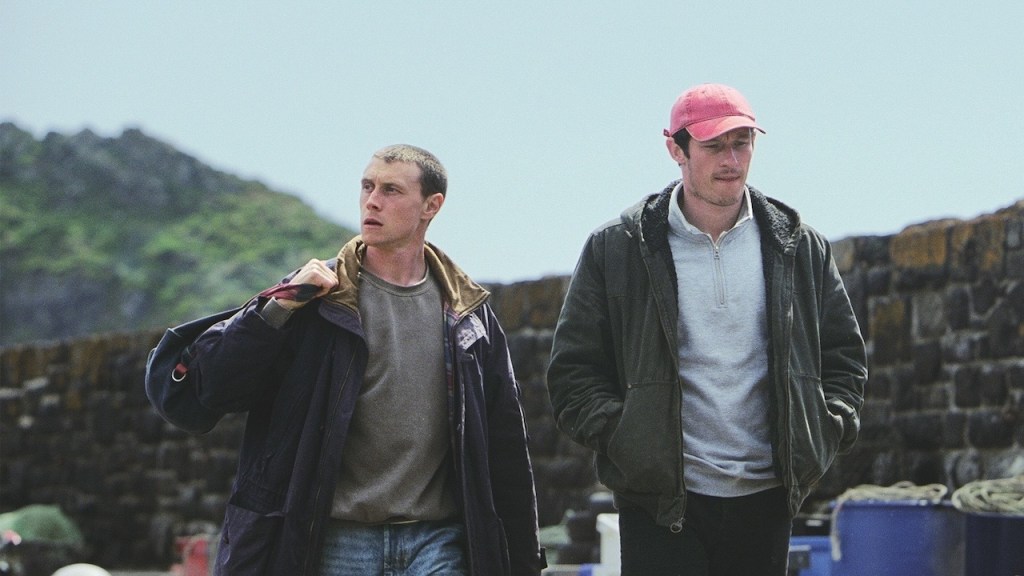
Taking place in a struggling fishing village, the film follows the events after the Rose of Nevada – the titular boat, which was previously lost at sea thirty years ago – mysteriously reappears in the old harbour. Not long after its surprise homecoming, a new crew, consisting of deckhands Nick (George MacKay) and Liam (Callum Turner), and led by skipper Murgey (Francis Magee), is assembled for its next voyage. However, after a successful few days at sea the boat somehow slips through time upon its return, seeing the trio of fishermen arrive back to the same village, but being welcomed as the original crew.
Those well-versed in Jenkin’s filmography will be unsurprised to learn that there’s nothing particularly flashy about Rose of Nevada. Rather, its impressive authenticity that anchors its sense of place allows its science-fiction elements a similar grounding. You won’t find any DeLorean’s hitting 88mph or lighting-struck phone booths here. Instead, the vessel for the characters’ journey through time is an unremarkable and rather weathered trawler, one that quietly slips into the past without ceremony or spectacle. Nevertheless, Jenkin’s eye for detail ensures that there’s still a richly textured feel to his picture. Shot on 16mm on location in Cornwall and using a Bolex camera, Rose of Nevada has a gritty, nostalgic quality to it. Whether it’s the rusted cleats of the boat or the stained brick of the harbour walls, every detail feels real and tangible.
Unlike the grayscale aesthetic of Bait, Jenkin gives Rose of Nevada an arresting visual landscape saturated with vibrant colours. The sky is full of bold blues, while the ship’s deck is punctuated with the bright yellows of Nick and Liam’s overalls. Yet, this wealth of warms hues and striking shades is somewhat at odds with its less affluent setting. One of the film’s first scenes sees Nick visit the village food bank, while he later tends to a leaky roof himself; it’s apparent that money is tight. While the largely deserted harbour eventually completes the picture of a once prosperous coastal community, now clearly cast aside.
Jenkin uses the time-travel elements to explore this portrayal of poverty over the years, comparing the then to the now. At first the changes are quite subtle; there’s a hustle and bustle about the harbour that feels unusual, people have a bit more loose change in their pockets and the local boozer is full to the brim. It’s only when Nick and Liam venture home, encountering more significant individual changes, that they’re forced to confront the reality of their trip through time. Perhaps their identities have been predestined, simply to fulfil a larger role in servicing their own community, but at what personal cost?
As Nick and Liam, it’s questions like these that George MacKay and Callum Turner must tackle as they navigate Rose of Nevada through its thematic currents. Both feel right at home in the perceptible world that Jenkin has created; Turner is happy-go-lucky as Liam, content to let the tide take him where it pleases, preferably to the pub with enough pay in his pocket for a few pints. Whereas MacKay is more reserved, showcasing Nick’s more responsible nature. After all he’s got more at stake, well at least in the present he does. Both are well cast in their respective roles and their later conflict is convincing. The rest of the cast is padded out with some of Jenkin’s regulars, including the likes of Mary Woodvine and Edward Rowe who afford the film the atmospheric appeal that audiences are now accustomed to with Jenkin’s work.
Like Enys Men, it too has a haunting quality, but what will come as a relief to many, is that Rose of Nevada is far more accessible than his previous film. The study of its small village, a type of setting often untouched by the passing of time, at least in appearance, lends itself so well to this kind of transportive sci-fi story. With the inheritance of both trade, and trauma, from each generation to the next feeling inevitable, it reflects the struggles of these places that time has forgotten. All the while Jenkin thoughtfully ponders if the solutions needed to move forward in the present, are actually to be found in the past – and more pressingly, what might have to be sacrificed to obtain them.
Star Rating: ★ ★ ★
Rose of Nevada will be released in cinemas on 24 April.


 Not Too Loud
Leave a comment