Directed by: Oliver Hermanus
Written by: Ben Shattuck
Run Time: 2 hours 8 minutes
Paul Mescal and Josh O’Connor’s careers are in rude health. Whether it be awards contenders, franchise favourites or acclaimed indie dramas, each of the young actors have several to their name. With both exploring queer roles too, they’ve not only become two of Hollywood’s most sought-after leading men, but two of the most versatile. And as their careers have steadily grown, so has anticipation for Oliver Hermanus’ romantic period drama, The History of Sound, first announced in 2021.
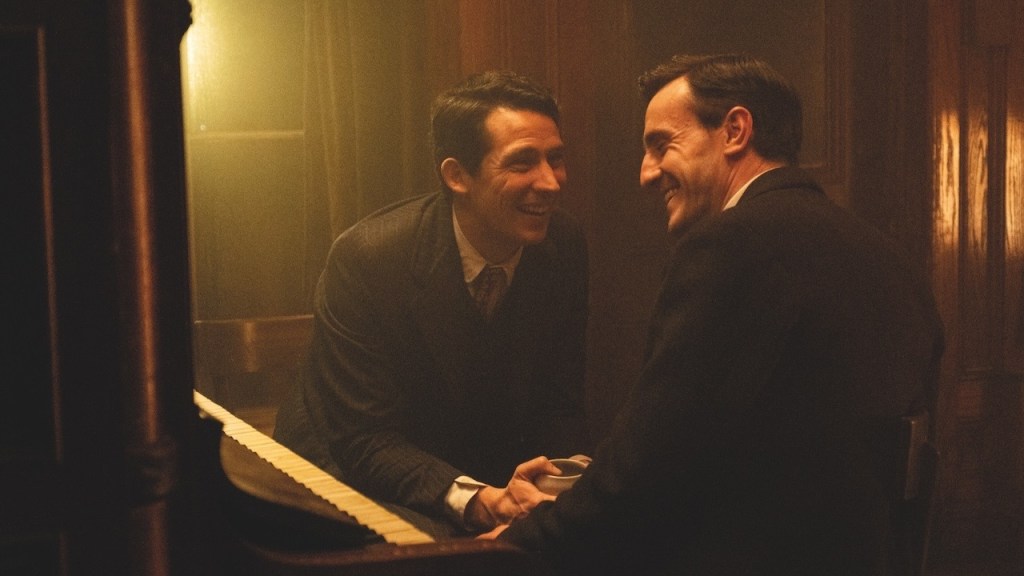
Adapted from two short stories by Ben Shattuck, the film follows students Lionel (Paul Mescal) and David (Josh O’Connor) who are studying at the New England Conservatory of Music in 1917. The pair become close but when the US joins World War I David is conscripted and the conservatory is closed. After a number of years apart they are eventually reunited when David invites Lionel to accompany him on a song collecting trip, commissioned by Maine College where he now works. Lionel gladly agrees and they spend the winter travelling across the state together recording songs on wax cylinders.
It’s the quaintest of concepts, and one that has such deeply wholesome appeal. The transitory nature of the plot, seeing the pair travel from location to location, gives the story the feel of a road trip film but instead of driving, Lionel and David trek through the state’s rural forests moving amongst nature and camping between stops. There’s a wonderful serenity to these surroundings and it’s further enhanced by the rustic costume and production design on display too. This is a lived in, tangible setting that allows its characters to properly come alive. And there’s a story to be told at each of their recording sessions, learning about the various communities and the songs of their people, all the while Lionel and David’s story is quietly being composed too.
Their romance is very naturalistic though, and much is left unsaid. Perhaps it will be too sparse for some, but there’s so much feeling in both performances that means lengthy dialogue isn’t always needed. Mescal in particular is very endearing, so obviously taken by his new friend it’s a delight to watch him fall further and further in love. There’s no overdrawn “will they, won’t they?” and much of the necessary exposition regarding their relationship is implied rather than spelled out. O’Connor is more guarded as David, but his attentive gaze as Lionel explains the concept of sound to some youthful ears is more than enough to reveal his affection. Managing to avoid a considerable number of queer film tropes admirably, Hermanus simply presents their love almost out of time, unbothered by circumstance, even if, ultimately, it still dictates much of their story.
Within their journey, and as you might expect considering the film’s sonic title, music has a notable prescene throughout. It’s the medium that first brings Lionel and David together, as they bond over a song that reminds Lionel of home, before then sharing more music with each other. Both Mescal and O’Connor spend much of their screen time in song, whether that be enjoying that of those they are collecting from or themselves directly serenading one another. Their voices bring with them much expression and tenderness, while their characters’ quest for undiscovered songs sees a greater cultural significance afforded to the music and lyrics of the time. Together they make for perfect narrative accompaniments: the larger societal importance of music and the more personal quality to it. While the characters’ vocal melodies create a love language that not only fashions a cinematic romance that effortlessly alludes to the various rhythms of their relationship over time, but also that, as a viewer, is a complete comfort to be enveloped in.
However, there is a little difficulty as this story approaches its cinematic coda. Maybe because it’s such a melancholic joy to sit in there’s a reluctance to move on – it could linger far longer than it does – but the finishing chapters lack a certain finesse. The use of flashbacks can feel a little clumsy, utilised mostly to set up moments years in the future but that play out back-to-back on screen. Yet, these are trivial complaints because the genuine heart of these scenes – an epilogue featuring Chris Cooper as an older Lionel in particular – are enough to emotionally floor its audience once more, delivering a perfectly placed poignancy.
And in offering its audience this especially sensitive reflection on love, much like its enthralling subject matter: music, allows Hermanus the power to emotionally connect viewers to their own devotions. As with two leads so in tune with each other, narrative beats so sincerely beautiful and many a musical moment that’ll make you cry, The History of Sound sings a cinematic song that rings achingly true.
Star Rating: ★ ★ ★ ★


 Not Too Loud
Leave a comment