Directed by: Ira Sachs
Written by: Ira Sachs
Run Time: 1 hour 16 mins
An actor or director’s genuine passion for a project can both help or hinder a production, but in the case of Peter Hujar’s Day, it’s the very reason that it exists at all. In a collaboration between writer-director Ira Sachs and actor Ben Whishaw, reuniting after Passages (2023), the pair have given life to an obscure, single-location drama which essentially acts as an extended monologue. With an absence of mass appeal or lucrative potential, it’s most certainly a product of real interest and definite fervour.
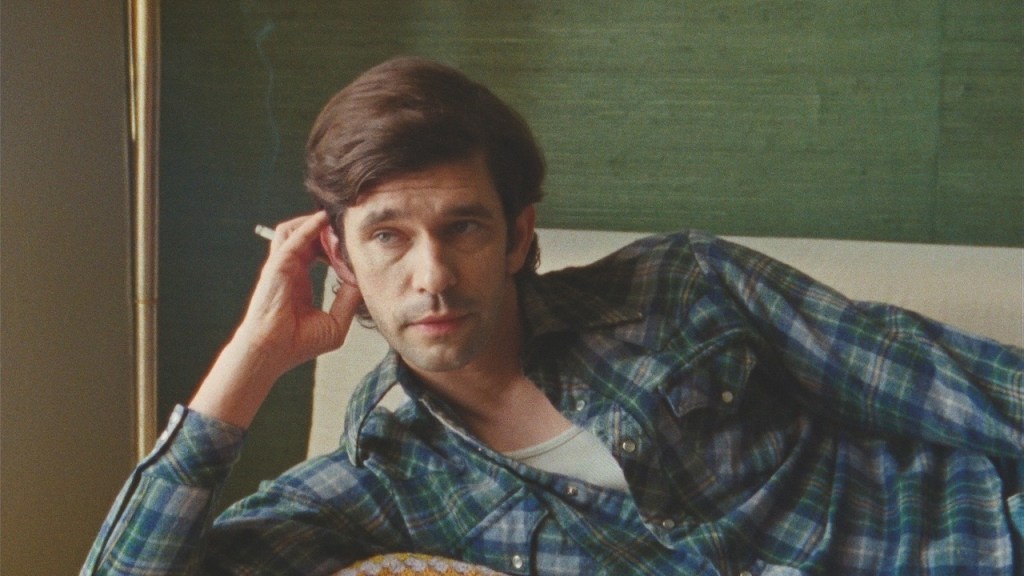
In 1974 writer Linda Rosenkrantz (Rebecca Hall) had the idea to collect a series of day in the life accounts from her friends living and working in New York, including that of photographer Peter Hujar’s (Ben Whishaw). Sachs’ film depicts the friends meeting at Rosenkrantz’s apartment where Hujar leisurely recounts the details of the previous day, including shooting a portrait of Allen Ginsberg for the New York Times, and it is the transcript of this interaction that Peter Hujar’s Day is based on.
Undoubtedly, many will find this premise far too simple. The film’s plot, if you can call it that, is obviously uneventful, but aptly asks its audience to consider and appreciate the mundane, inconsequential details of daily life. Albeit, it’s the day in the life of an intriguing artist from 70s New York that is being documented, but despite this, moments of tedium of course still arise. In Rosenkrantz’s insistence for detail though, she brings a level of attention to the trivial that’s usually lost amongst the more significant sections of our days. Here the nuances of Hujar’s handwriting as he decides how to sign one of his prints, or his fashion dilemma of which coat to wear to meet a client take centre stage. Whether it simply be in the slowing down or in the examination of minor judgements, there’s value in giving these inner musings a moment of external existence.
Through this often delightfully relaxing retelling of his day, different aspects of Hujar’s character are gradually revealed, perhaps less from the specific content of what he did only hours before, but more in how he relives and considers it. He quickly learns how adept and natural he is at lying, and apparently for no real reason at all. His constant reach for his cigarettes in between sentences highlights a habit he can’t stop. While his assessment of his business dealings suggests a lack of self-worth. It’s these small insights that make his account all the more interesting, while also illuminating various elements of his character.
The same can’t be said of Rosenkrantz, but this isn’t an interview, it’s barely even a dialogue. She’s there to facilitate her idea and subject, in this instance Hujar. Although in her brief interjections she does reveal her reasoning for creating the project, stating she’s unclear on how she fills her own days so is curious to learn how others do. This alludes to the fact that she maybe feels somewhat unremarkable in her purpose and likely uninspired in her setting, but it’s all that can really be gleaned from her character. She’s not explored any further, but with this premise, why would she be? Rebecca Hall is appropriately unassuming, but not invisible in the role, helping to create a space that she feels a part of, while ultimately serving the narrative and supporting her co-star.
Co-stars is perhaps a generous way to define the duo though, considering the vast discrepancy in lines; Ben Whishaw has fifty-five pages worth, while Hall has a mere three. It’s worth noting that this is a simple result of the premise and not a criticism, but thankfully one that Whishaw is more than capable of tackling. He looks and sounds the part, with a humble yet stylish wardrobe that speaks both to his artistry and his queerness, and a convincing American accent to deliver his wealth of lines with. These make for a persuasive Peter Hujar, while his gentle demeanour and soft tone allow him to become a thoroughly watchable and soothing presence, welcoming viewers to come and nestle into the soft furnishings of Rosenkrantz’s apartment right alongside him.
This setting is an addition that’s just as inviting as Whishaw’s calmly compelling central performance. The apartment feels rich, not in its monetary value, but in the lived in quality of its appearance. Its range of alcoves and angles, captured beautifully by Alex Ashe’s cinematography, keep the space engaging without ever succumbing to the often claustrophobic restraints of a single-location setting. Sachs has created an environment that makes his characters comfortable, but crucially leaves enough space for his audience to make themselves at home too.
And at only 75 minutes there’s no risk of Peter Hujar’s Day overstaying its welcome, in fact audiences would probably be content to stay in this company a little longer. After all the ease that Sachs and Whishaw put all parties at allows this glimpse into the everyday life of an artist to really breathe, staying true to the nature of Rosenkrantz’s original idea. There’s nothing particularly revelatory about it, but its simplicity and truth in presenting things exactly how they are, or at least however honest Hujar has been, gives the picture a rare vulnerability that like the last stretches of NYC sunlight reaching Rosenkrantz’s apartment, is worth basking in.
Star Rating: ★ ★ ★



 Not Too Loud
Leave a comment