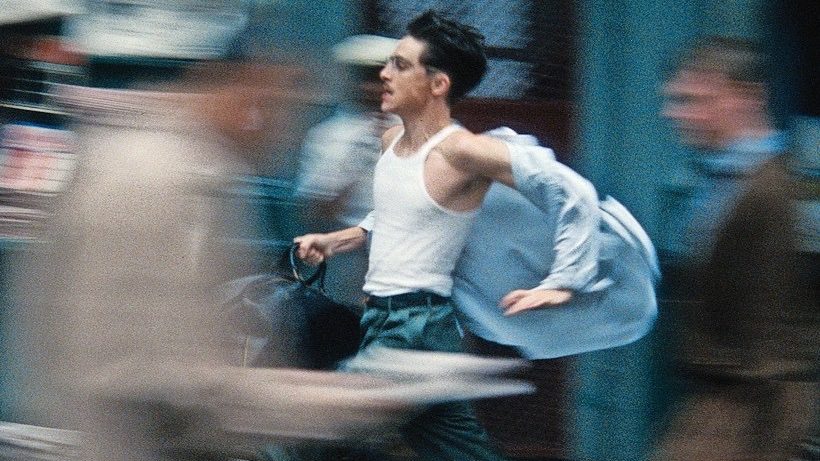
Directed by: Josh Safdie
Written by: Josh Safdie and Ronald Bronstein
Run Time: 2 hours 30 mins
It’s somewhat ironic that despite parting ways in early 2024, both Safdie brothers have followed similar trajectories with their first films since the split. Benny Safdie recruited Dwayne Johnson to portray MMA fighter Mark Kerr in The Smashing Machine (2025), while Josh Safdie has teamed up with Timothée Chalamet to tell the story of table tennis star Marty Reisman in Marty Supreme (2025). And with both sporting dramas ranking amongst A24’s most expensive films to date, it’s clear that the company consider the duo just as valuable apart as they do together.
Set in 1950s New York we meet Marty (Timothée Chalamet) at his day job in his Uncle’s shoe shop. Although it quickly becomes clear that this isn’t Marty’s true calling, in fact he’s only taken the job to save up money to pursue his dream of being a professional ping-pong player. Already fairly established in the sport, he competes in the British Open, but his sights are set on the World Championships in Tokyo, where he seeks a rematch with his rival, and Japan’s star player, Koto Endo (Koto Kawaguchi). But with finances running low Marty is forced to resort to increasingly extreme measures in order to secure the money he needs to attend.
What follows is a chaotic race against time, resulting in a picture that feels more like a crime thriller than a sports film. As Marty gets caught up in countless unhinged antics, each more outlandish than the last, it takes on the relentless pace of both Good Time (2017) and Uncut Gems (2019). Safdie’s screenplay, co-written with frequent collaborator Ronald Bronstein, is full of genuine surprises – both in its action and its dialogue – that audiences simply won’t expect from a sports drama. The table tennis provides suitably thrilling viewing too, offering athletic action that’s as easy to follow as it is exciting to watch. Yet Marty Supreme isn’t really the sports biopic it’s being billed as, and it’s all the better for it.
Safdie, while proficient and stylish in his portrayal of the sport, offers an additional angle to the film through his exploration of his protagonist’s extreme narcissism, doing so in a manner that impressively avoids alienating his audience. Marty is so deeply driven in achieving his entitled American Dream that he can’t even entertain the idea of doing anything else. His relationships are often shallow, his actions are commonly desperate and there isn’t a moral low that he won’t stoop to. All things considered, he’s reprehensible, yet somehow he’s completely magnetic.
It’s no mystery either, as Timothée Chalamet’s leading turn is as accomplished as they come. Marty Supreme is a cinematic rally, constantly taking audiences in unexpected directions, and Chalamet is the paddle propelling it. He portrays Marty’s conceit with the necessary confidence to make it convincing, while underpinning it with a dash of charisma that as a viewer it almost feels wrong to be drawn to. Additionally, it could be his transfixing desperation, his uncontrollable need to be the best that makes him so compelling, but either way Chalamet ensures that rather than be infuriated by Marty – which would be a completely valid response – audiences become invested in him and his inconsiderate demand for greatness.
Rather aptly then, this superb turn insists on being mentioned alongside Chalamet’s best. It’s the type of committed, exhilarating performance that could define an actor’s entire career. He’s been delivering great work for years, but he’s undeniable here in a way that we’ve not yet seen from him – accelerating through a two and a half hour epic in a brash and unapologetic manner, one that commands attention and acclaim while confirming, whether you want to admit it or not, he is the definitive leading man of contemporary Hollywood.
To achieve this while surrounded by such a commendable supporting cast indicates a further mark of a leading man with the promise of real longevity. Among them, Gwyneth Paltrow stars as Kay Stone, a retired actress who becomes the object of Marty’s desire while both staying at the Ritz London. Her association with Marty is one of the film’s most intriguing, initially projecting immunity to his audacious advances before later succumbing to them. Paltrow offers Kay a poise, that combined with her prestige, places her in a unique position that’s constantly shifting along with the power dynamic of their curious relationship.
A further cast highlight is Kevin O’Leary – Canadian businessman and star of Shark Tank – who plays Paltrow’s onscreen husband Milton Rockwell. He’s so good as the shrewd stationery mogul – in his first ever film role! – that he creates the illusion that he’s been a movie star for years, you’ll find yourself asking “what else have I seem him in?” His involvement brings with it Safdie’s musings on capitalism in post-war America, while simply providing Marty another tool to utilise in his arsenal of arrogance as he strives for ultimate dominance in his sport.
Much of Marty Supreme is about this very give and take though; how much can Marty exploit a situation, an opportunity, an introduction, to help make his dream come true. It’s as rousing watching him navigate these moments as it is facing opponents at the table. OPN’s electric score captures the scale of this ambition wonderfully. In places it’s evocative of Tangerine Dream’s work, both feeling futuristic for the time period and by embracing elements of film’s 80s inspired soundtrack, nostalgic for viewers. It works both as the soundscape for Marty’s constant hustle and as the accompaniment to the fast pace present for much of the film.
And while it adds energy to the proceedings, in a welcome change there isn’t the same tension as some of the Safdies’ previous work. As alongside the stakes of certain scenes comes a naturally flowing humour, often at Marty’s expense – another clever tactic in keeping audiences onside – that steadies the often uncontrollable spiral of events unfolding. There’s comedy in the extremity of his narcism, but there’s also a sadness in his insecurity, no matter how well he thinks he has it masked. But by the time Marty Supreme arrives at its final moments, Safdie suggests this guard could finally be coming down, although judging by the excessive entitlement that’s brought Marty here, it surely can’t be for long.
Star Rating: ★ ★ ★ ★


 Not Too Loud
Leave a comment