Directed by: Clint Bentley
Written by: Clint Bentley and Greg Kwedar
Run Time: 1 hour 42 mins
Despite not quite obtaining the same level of fame as some of his more celebrated contemporaries, Joel Edgerton is perhaps one of Hollywood’s most diligent stars. His work over the last few decades – including two very commendable directorial efforts – has largely been of a consistent quality and offered a real variety of characters and stories. His new film, Sundance hit Train Dreams, won’t be the project to garner him any substantial mainstream fame, but if there’s any justice, it will be the film that earns the actor the long overdue acclaim that he so deserves.
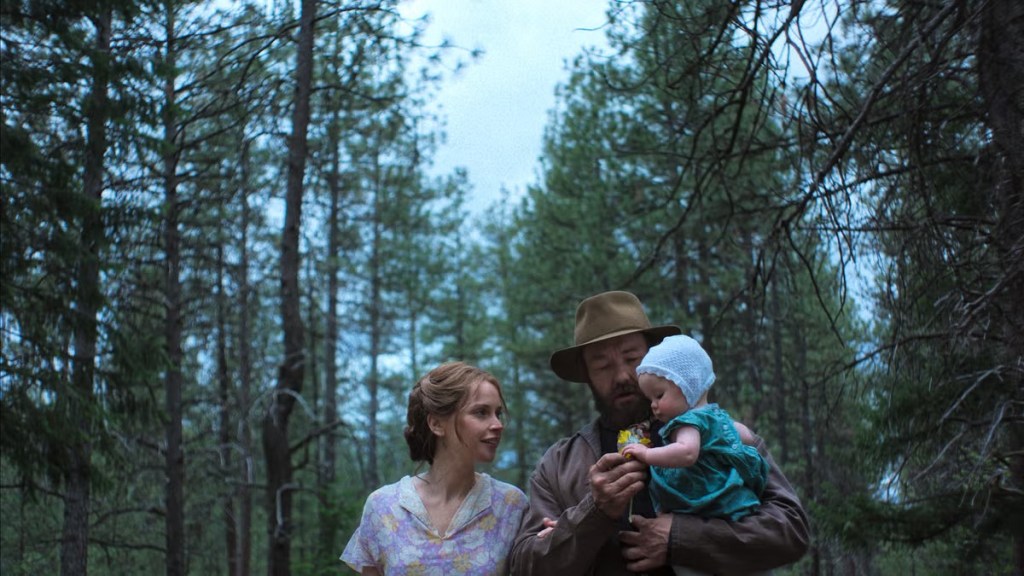
Train Dreams follows a humble construction worker and then logger, Robert (Joel Edgerton), charting his life in Bonners Ferry, Idaho from his early childhood through to his later years. In between, he meets Gladys (Felicity Jones) and together they start a family, welcoming a little baby girl into the world. However, amidst his many blessings, over the years Robert also endures a number of intense hardships, several so severe that they send him spiralling into an often hopeless search for meaning.
The film gets underway with the gentle narration of Will Patton who calmly introduces Robert and subsequently guides audiences through the rest of the film. His soft, unhurried line delivery sets the tone wonderfully, one that punctuates the narrative trails of this tender drama quite beautifully – something also true of Adolpho Veloso’s stunning cinematography, which captures the dense forest setting strikingly. When Patton falls silent, it’s Bryce Dessner and his stirring score that then envelops the picture in this profound poignancy – a feature that is felt throughout the entirety of the film.
It’s a mood not only translated through the soothing auditory elements and attractive visuals of the film, but also in the calibre of its sensitive writing. Adapted by director Clint Bentley and co-writer Greg Kwedar – the pair behind the Oscar-nominated Sing Sing (2023) – it’s no surprise then, that Train Dreams becomes so quietly compelling. It delicately taps into that universal expectation that the definitive purpose of our lives will eventually become clear to us, but its kind-hearted honesty goes on to confront the reality that sadly, this isn’t always the case. It’s not cruel or cold in this realisation though, instead acknowledging and sympathising with the deep sense of sadness that can unfortunately accompany it.
As Robert, the rendering of this invariably human struggle, Joel Edgerton is magnificent. He adapts to the earthy woodlands with ease, seemingly becoming one with his impressive surroundings, even if he himself frequently feels at odds with this world, and more specifically, his place within it. At first tormented by guilt after witnessing a heinous crime in his workplace, his torture soon turns to grief, mourning the loss of all he once lived for. His character is a man of few words but the ones he does utter are full of contemplative thought and a touching search for meaning, all imparted by Edgerton with a painful realism and acceptance that’s as upsetting as it is convincing.
Robert’s story spanning so many years allows for a range of characters to come and go as do the shifting seasons of his life. Of course there’s his dear wife Gladys played by Felicity Jones with an old-fashioned charm. However, it’s elsewhere in the supporting cast where the real standouts emerge. Most prevalently is William H. Macy’s eccentric logger Arn, who just so happens to double as an explosives expert. He brings a genuine, real-world humour to the picture, in turn unlocking an unexpected connection with Robert. Similarly, Kerry Condon’s enthusiastic outpost attendant Claire later encourages a level of social interaction with him that at this point barely feels like a possibility anymore.
This is exactly what makes Train Dreams so moving though: its hushed determination to be hopeful. It repeatedly reminds us that even after devastation there’s opportunity for relationship, and the loneliness of loss doesn’t render one invisible or unimportant. That even the smallest branch in a forest full of five-hundred-year-old trees isn’t insignificant, nor is a lonely man waiting patiently in his cabin by the lake.
Star Rating: ★ ★ ★ ★




 Not Too Loud
Leave a comment