Directed by: Helen Walsh
Written by: Helen Walsh
Run Time: 1 hour 51 mins
Whether it’s cowboys Ennis and Jack in Brokeback Mountain (2006) or farmers Johnny and Gheorghe in God’s Own Country (2017), queer cinema has often explored narratives of young men in working-class settings confronting their repressed sexualities. There’s many more examples too, amply populating the genre with stories of similar sentiment. Yet despite such an established collection already existing, with new drama On the Sea, writer-director Helen Walsh adds another.
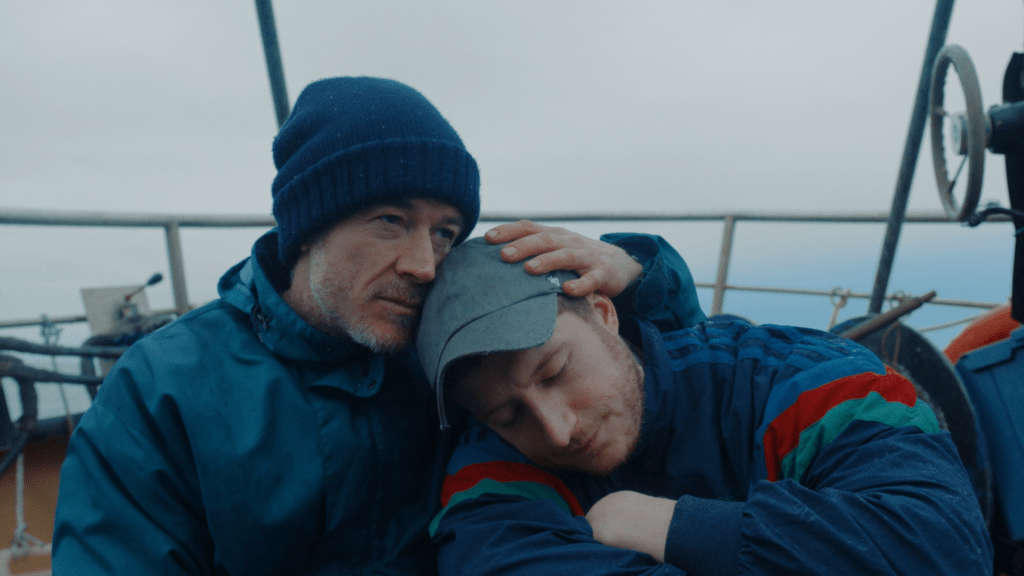
Set in a small coastal community in North Wales, On the Sea follows local fisherman Jack (Barry Ward), who operates a modest mussel business with his younger brother Dyfan (Celyn Jones). Married to his childhood sweetheart Maggie (Liz White), Jack hopes that one day their teenage son Tom (Henry Lawfull) will follow in his footsteps and join the family trade. But when Daniel (Lorne MacFadyen), a young fisherman drifting between jobs, arrives in town, Jack finds himself increasingly distracted and is forced to wrestle with his developing feelings for him.
While there’s a definite familiarity to this kind of story, in this instance, the unique sense of place found in its rural Welsh setting gives it more weight – after all, aside from Matthew Warchus’ Pride (2014), there aren’t too many other queer dramas from Wales out there. Additionally, the fact that the main character here is middle-aged (Jack isn’t far off fifty) provides another alternative angle to appreciate, further setting it apart from the numerous titles it will likely draw comparisons to. However, even with these distinguishing features set to one side, thanks to its abundance of sincere feeling, On the Sea stays firmly afloat all of its own accord.
This story isn’t just treading water though, as Barry Ward’s sensitive leading turn forges the film forward as Jack attempts to navigate his feelings for Daniel. Ward conveys his longing with much poignancy, presenting Jack as an almost vacant figure, certainly lacking a particular intimacy that his marriage just can’t provide. Although, his portrayal of Jack isn’t solely a sombre one. He finds joy in the subtle change of Jack’s expression as Daniel comes into view over a hill, or in his soft physical touch as the pair share the precious closeness that he’s not previously experienced. These moments, while often fleeting, provide Jack with a gentle glee and rare lightness that allow him the chance, for the first time, to voyage through life fully as himself. Portrayed wonderfully by Ward, he delivers a really special performance that truly makes waves.
His co-star, Lorne MacFadyen, is similarly stirring as this enchanting drifter offering Jack the very thing he’s wanted for so long. His charm and authenticity align in a way that allows audiences to understand Jack’s intense attraction towards him, while the couple’s powerful chemistry ensures that the central romance between them is as convincing as it is endearing. Elsewhere, the remaining cast are reliable in their respective roles too. As Jack’s younger brother Dyfan, Celyn Jones acts as a staunch representation of the regressive views prevalent in their family’s small coastal community setting, while Liz White gives an impassioned performance as Jack’s unsuspecting wife Maggie. However, even competent performances such as these can’t completely steady the narrative which loses some balance in its final stretch.
Of course while the majority of the film focuses on Jack and Daniel, the third act does take a degree of the attention away from them. Sadly, in doing so, On the Sea forgoes some of the natural rhythm it’s found over the previous hour or so. However, this change in approach isn’t without merit as there’s a real sadness here, one that Walsh chooses not to ignore, but rather fully embrace, capturing it vividly. Subsequently, this story can be a difficult watch in places and may be too bleak for some. Yet while on the surface there’s much sorrow present, with a dive slightly deeper there’s a more uplifting facet to be found.
As in eventually finding the courage to live as his true, authentic self, Jack achieves all that any of us can really hope to do. In heartrending fashion, On the Sea reminds us that – much like Walsh’s tender contribution to this enduring subgenre – it’s far better late, than tragically never at all.
Star Rating: ★ ★ ★




 Not Too Loud
Leave a comment