Directed by: Kelly Reichardt
Written by: Kelly Reichardt
Run Time: 1 hour 50 mins
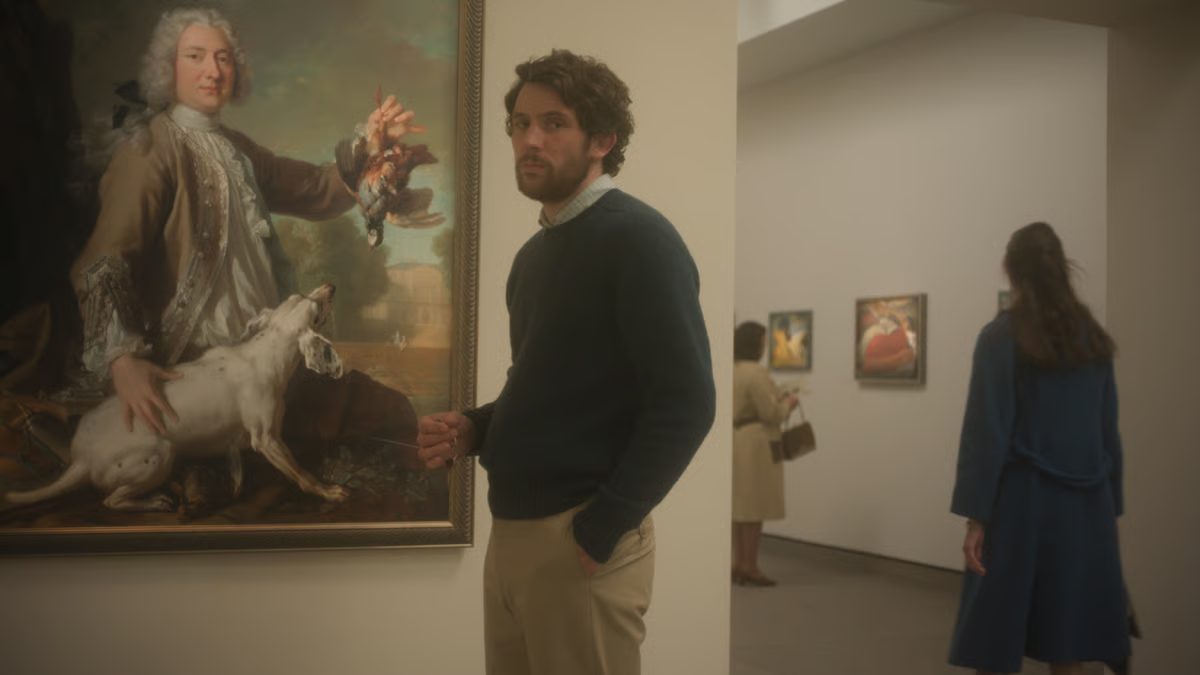
A heist film written and directed by Kelly Reichardt – it sounds almost contradictory. The flashy, high-octane thrills typical of the genre feel completely at odds with Reichardt’s more measured, meditative filmmaking. But perhaps it’s this very tension that makes this director-genre pairing all the more intriguing. After all, framed by a leading turn from the excellent Josh O’Connor, The Mastermind curates quite the curious cinematic exhibit, one not just to consume, but to contemplate.
Set in 1970s Massachusetts, against the backdrop of anti-war protests and national unrest, the film follows a talented but struggling carpenter James Mooney (Josh O’Connor) as he quietly orchestrates a modest art heist. Targeting his local small-town museum, events don’t go exactly to plan and the post-robbery chain of events force James into an aimless life on the run. Meanwhile, his wife Terri (Alana Haim) and their two young children are left wondering when, if ever, he’ll return home.
Make no mistake, this is no Ocean’s Eleven (2001). There are no polished montages mapping out the logistics of the robbery, nor any smug, slow-motion getaway sequences. Instead, Reichardt lingers on the more mundane mechanics of this crime – the sewing of burlap bags to carry the paintings, the weary bus journeys while on the run, the leisurely walks taken to fill time between hideouts. That’s not to say there isn’t action; by Reichardt’s standards, this might as well be her Die Hard (1988). The heist itself is captured in relatively uncomplicated fashion, but one that offers a rare burst of energy in an otherwise sedate state of affairs.
Post-heist, Reichardt reverts to her usual, more relaxed pace – one that may well be too meandering for most. She demonstrates her reluctance to heighten suspense or increase intensity with an extended sequence of James hiding the paintings. On the surface, it’s rather unremarkable – almost uneventful – yet it’s here where her character study really begins to come into focus. As it’s in the humdrum and tedium that she takes aim at the mediocrity of her main character – a mastermind he is certainly not, made clear from the arbitrary aftermath that sees him float from town to town, attempting to formulate some semblance of a plan as he goes.
Although Reichardt’s ironic title is just the starting point for her delicate deconstruction, one that quietly exposes James’ privilege and entitlement. His middle-class upbringing is made apparent throughout the film, whether it’s his impressive family home or his parents’ – played by Bill Camp and Hope Davis – underused membership to the local museum, it’s made quite clear that the Mooney’s have a more comfortable position in society than most. With this comes James’ indifference to hard work and an expectation that he’s owed something: handouts from his mother, childcare from his wife, freely given food and shelter from friends – all to be willingly offered up, no questions asked.
As James, Josh O’Conner embodies this presumptuous quality wonderfully. Unlike the conventions of the heist genre, he’s a perfect fit for Reichardt. He easily settles into to the sleepy rhythms of her storytelling – nestled in his cosy knitwear, but not quite as cool as the jazzy score underpinning much of the drama. He’s hardly interesting enough to be an art thief, but O’Connor wears the 70’s aesthetic so well that it lends James a credible, lived-in quality, reliably anchoring the film’s more muted appeal.
O’Connor’s assured delivery of James’ varying desperation and disbelief at different points further supports Reichardt’s gently comical takedown of his character. While elsewhere, Gaby Hoffmann is another – and perhaps the sharpest – of her instruments used in this dissection. As the deeply unamused Maude, partner to James’s more accommodating friend Fred (John Magaro), she puts him firmly in his place in a way he’s clearly unaccustomed to – a new, uncomfortable position that will ask him how far he’s willing to go to remain at large.
However, the irony is rich given the broader context of the Vietnam War, present in both his and the audience’s peripheral vision throughout. While other men his age are either fighting on the front line or protesting against it, James’s privilege ensures that his greatest concern is simply finding the next friend or family member to scrounge off. Never mind the art — the real heist of The Mastermind is how he’s managed to get away with being so casually brazen for as long as he has.
Star Rating: ★ ★ ★




 Not Too Loud
Leave a comment