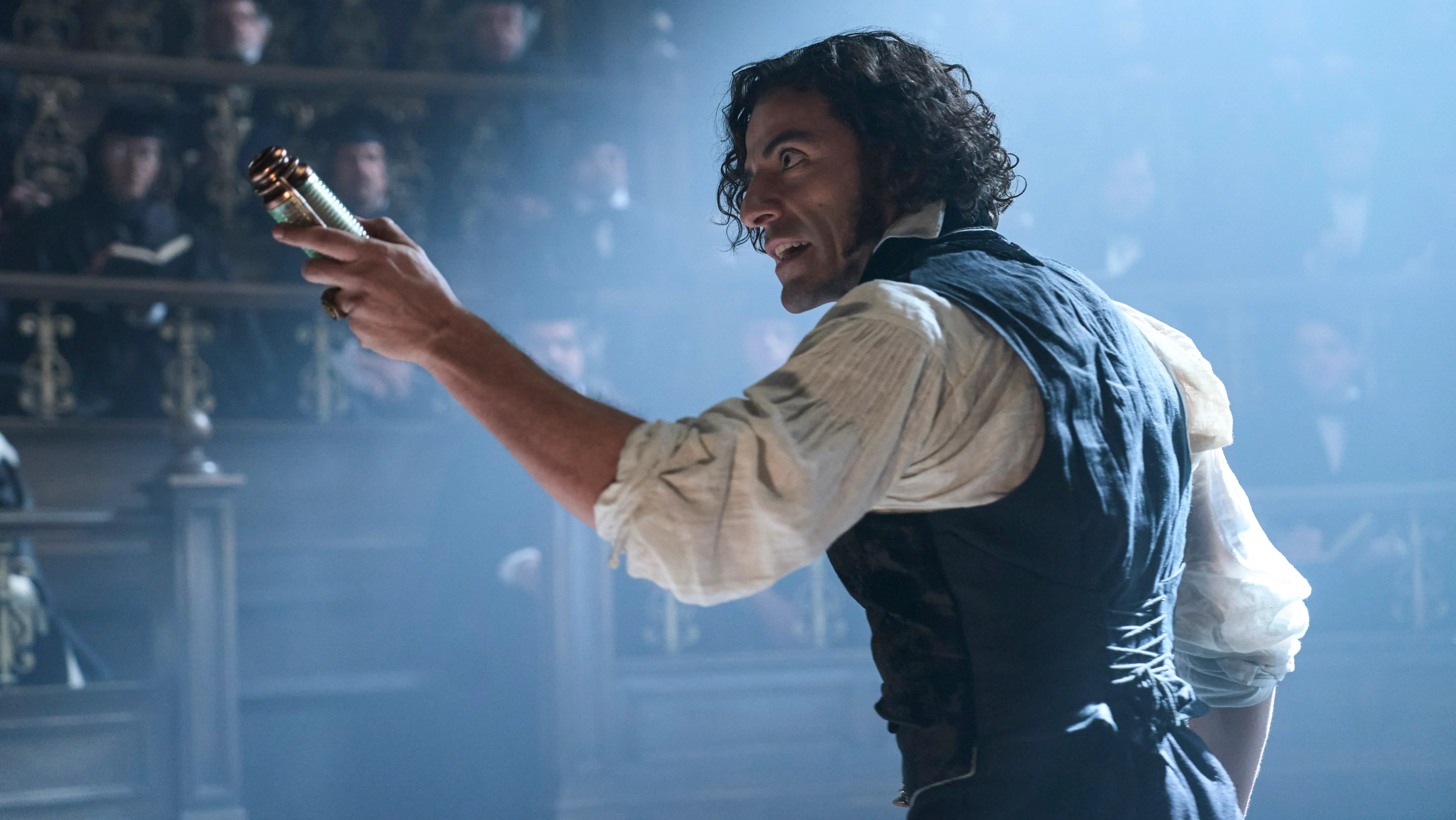
Directed by: Guillermo del Toro
Written by: Guillermo del Toro
Run Time: 2 hours 30 mins
With both Nightmare Alley (2021) and Pinocchio (2022) director Guillermo del Toro’s fondness for reimagining classic stories has become abundantly clear. But the adaptation he’s long dreamed of – Mary Shelley’s Frankenstein, his favourite novel – has always eluded him. Never quite making it to production, despite numerous attempts, it’s Netflix that have stepped in to spark new life into the project. And now, finally, Guillermo del Toro’s Frankenstein is alive, it’s alive!
The film follows Victor Frankenstein (Oscar Isaac), a talented scientist obsessed with conquering death. His spirited demonstrations attract the attention of Henrich Harlander (Christoph Waltz), a wealthy arms dealer who recognises the possibilities of Frankenstein’s research and offers to fund his experiments. With Harlander’s backing, Frankenstein’s efforts culminate in the creation of a creature (Jacob Elordi) assembled from a patchwork of human remains. But with no consideration given to life beyond the point of creation, Frankenstein and his creature quickly become at odds with one another.
If you were to encounter this adaptation with no prior knowledge, it would still be easily identifiable as Guillermo del Toro’s Frankenstein. The colourful costume design and lavish sets – at times almost too polished – coupled with the tremendous practical effects are clear indicators of his trademark style. This vibrant aesthetic convincingly creates spectacle, giving this classic tale the suitable scale and grandeur it deserves. The only time that these opulent visuals lose their impact is when some more mediocre special effects obscure Dan Laustsen’s otherwise impeccable cinematography. These VFX aren’t bad, but when utilised alongside the more impressive practical effects, they just don’t compare.
Contemplating this visual style, and having witnessed a renowned horror be reinvented by way of Robert Eggers’ Nosferatu (2024) only months ago, it’s thrilling to see another interpretation of an equally as iconic monster, but engineered so differently. With its bold colours and warm lighting Frankenstein feels like the antithesis of Eggers, and del Toro’s differentiation doesn’t stop there, presenting this classic story far more like a fairytale than a horror. Even parts of Alexandre Desplat’s stirring score are surprisingly spritely considering the more traditionally eerie way that this cinematic chronicle has been previously told.
Del Toro effectively employs Shelley’s original framing device, opening with the Arctic expedition lead by Captain Anderson (Lars Mikkelsen). This structure helps divide the film into distinctive sections and allows both creator and creature to share their stories. Del Toro gives each perspective equal weight, exploring them in rich detail. Frankenstein’s arc offers a compelling portrait of one man’s determination to beat death, and ultimately in defying god he becomes one himself. While the creature’s story is one of self-reckoning as he confronts his own existence and the inevitable violence of the world that he’s been so cruelly brought into. And with neither of them being properly equipped to deal with the repercussions of Frankenstein’s irresponsible actions, the pair find themselves entwined in indefinite and mutual torment.
Both chapters are told with much versatility, taking their time to settle into the emotion and context of each episode, even if the start of the second part feels a little too meandering. Despite their differences both segments contain bursts of violence and gore – some shocking, while others darkly humorous. This sprinkling of comedy amidst such a bleak and disturbing tale is welcome, especially as it never overshadows the more thoughtful thematic work del Toro weaves throughout. As whether exploring gods and monsters, or life and death, there’s always an engaging search for meaning and purpose running parallel to the plot.
The vessels for this exploration are just as enthralling, with Oscar Isaac confidently leading as the titular scientist. His deceptive charm is always underpinned by a more sinister, egotistical edge, making his eventual anguish feel less sympathetic. In contrast, Jacob Elordi’s more physical, gentle-natured performance as the creature evokes deep empathy, particularly in his quiet yearning to belong. As Frankenstein’s soon-to-be sister-in-law Elizabeth, Mia Goth establishes much of the film’s emotion. She forges a deeper connection with the creature – one that breeds a soft innocence – while still maintaining a formidable presence among others. Meanwhile, Christoph Waltz delivers a reliably spirited turn as her onscreen uncle, adding energy and flamboyance to each of his scenes.
Carefully pieced together like the creature itself, this ensemble collectively ensures that Guillermo del Toro’s reimagining is both impressive and robust. Of course amply adding his own idiosyncratic flair and vibrancy to the picture throughout, his Frankenstein reads like the most earnest of love letters to its source material. One that recognises the horror, but too seeks out and embraces its tender beating heart.
Star Rating: ★ ★ ★ ★


 Not Too Loud
Leave a comment