Directed by: Robin Campillo
Written by: Robin Campillo, Laurent Cantet and Gilles Marchand
Run Time: 1 hour 42 mins
When it comes to landmark years for queer cinema, 2017 certainly stands out: Moonlight won Best Picture, Call Me By Your Name made a massive splash on the festival circuit, A Fantastic Woman marked a major milestone for trans representation, and 120 BPM took home the Grand Prix at Cannes Film Festival – the latter seeing director Robin Campillo attract much attention. Now, after his autobiographical drama Red Island (2023), he returns with his latest queer coming-of-age drama, Enzo. Originally set to be directed by co-writer Laurent Cantet, Campillo chose to take over in Cantet’s honour after his sad passing before filming began. As a result, Enzo is uniquely credited as ‘a film by Laurent Cantet’.
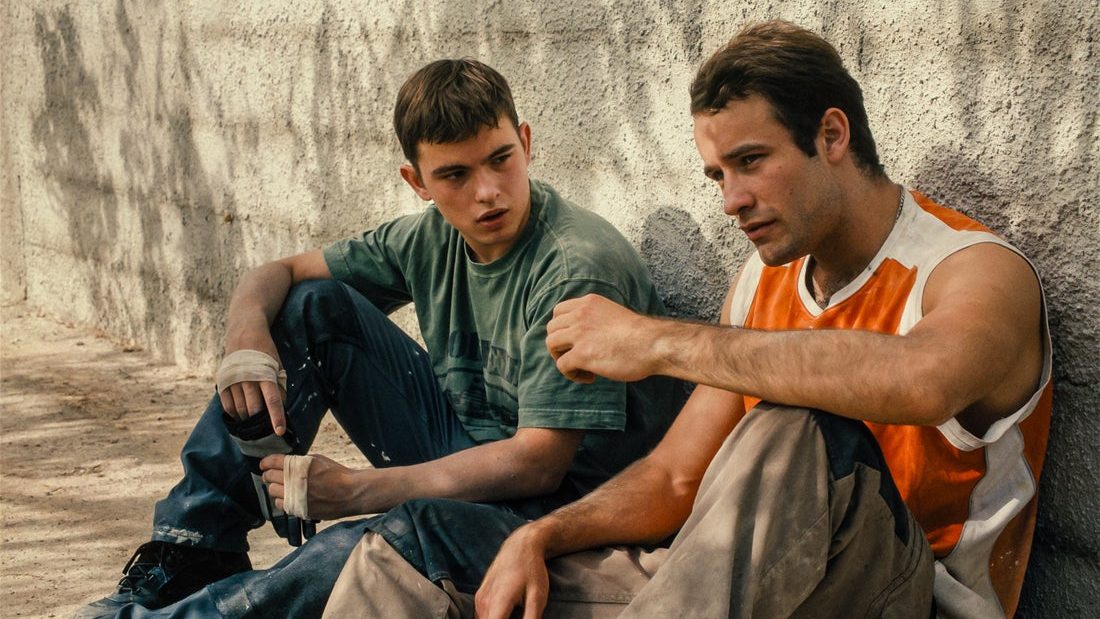
Enzo centres around its sixteen-year-old titular protagonist (Eloy Pohu), who shocks his wealthy family by becoming a bricklaying apprentice. Unsure of where he wants to take his life, he starts to develop a friendship with his Ukrainian colleagues Vlad (Maksym Slivinskyi) and Miroslav (Vladislav Holyk). Feeling more of a connection to their working class lifestyle and carefree attitudes compared to his own more middle-class upbringing, things start to become even more complicated when he starts to develop an infatuation with Vlad.
And while he becomes enamoured with Vlad, Campillo ensures that audiences are suitably enchanted themselves, inviting them to bask in all the stunning scenery Enzo has to offer. Jeanne Lapoirie’s cinematography is truly beautiful, making the sun-soaked town of La Ciotat look incredibly picturesque. A lot of the film explores the class divide between Enzo’s family and his Ukrainian colleagues, but what’s notable about Lapoirie’s cinematography is that it doesn’t discriminate. Often, films may use different visual styles to illustrate the disparity between neighbourhoods, but both Enzo’s hillside mansion and Vlad and Miroslav’s more humble flat block are presented as warm and sunny environments, effectively showing how Enzo is able to view both settings as home.
This special bond between the three becomes one of the film’s strongest attributes, proving particularly noticeable during one scene where Enzo hangs out with Vlad and Miroslav for the first time outside of work. While dancing and getting ready to go out clubbing together, it’s one of the very few moments where Enzo looks totally comfortable and happy. However, it’s disappointing that the film focuses more on Enzo’s developing crush on Vlad while almost completely ignoring Miroslav, as his character is potentially the film’s most interesting. Just turned twenty-five, he feels an obligation to return to Ukraine to fight in the war. But despite these worries, he’s a very optimistic character and played incredibly charismatically by Vladislav Holyk.
Conversely, as a teenager who shows very little enthusiasm or gratitude towards anyone, Enzo is the least interesting of the three main characters. In addition to this there’s not enough subtext presented for him to be any deeper than what’s seen on the surface, with the script mostly showing his strong emotions by simply having him storm out of situations. Overall, Eloy Pohu does a decent job of portraying the character; it’s just a shame that the script doesn’t give him much chance to make his performance more versatile.
Nevertheless, Campillo’s queer influence allows for a very subtle portrayal of sexuality. There’s no big speeches about what Enzo wants to label himself as and no exaggerated realisations of his feelings for Vlad. Instead, the characters are who they are without the need to explain themselves. This is also the case for Vlad, as his reactions to Enzo’s advances are thoughtfully left up to interpretation, with Maksym Slivinskyi expertly demonstrating the character’s uncertainty and worry for Enzo. Yet in the third act, the characters’ actions are portrayed quite clumsily; such bizarre things happen and are alluded to with no real payoff, to the point where it’s unclear if they’ve even really happened, giving the culminating chapter a somewhat irksome edge.
So while Campillo’s film doesn’t break any new ground for queer cinema, Enzo remains a solid story of understanding identity and exploring sexuality. It also boasts the exact type of finale that any good coming-of-age story should conclude with: open-ended, while still resolving this specific arc in the character’s life. One that, along with the gorgeous scenery, is hard not to get swept up in.
Star Rating: ★ ★ ★
 Not Too Loud
Leave a comment