Directed by: Alex Scharfman
Written by: Alex Scharfman
Run Time: 1 hour 47 minutes
In the years since Bong Joon-ho’s Best-Picture winner Parasite (2019) there has been an abundance of additional “eat the rich” films served up to audiences. Between Ruben Östlund’s Triangle of Sadness (2022), Mark Mylod’s The Menu (2022) and Emerald Fennell’s Saltburn (2023) – not an exhaustive list by any means – the cinematic study of status, class and the distribution of wealth has been unavoidable. And despite this oversaturation, Alex Scharfman’s Death of a Unicorn is the latest to try its luck at ridiculing the upper classes, but curiously, his takedown also doubles as a creature feature.
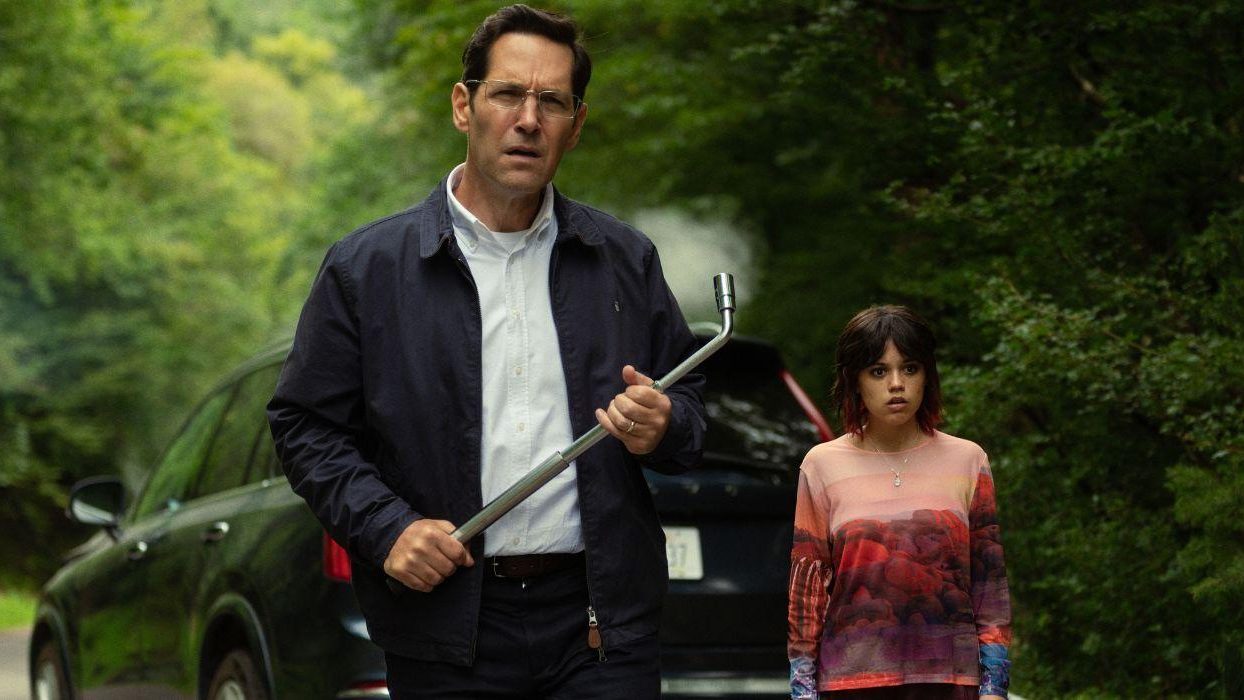
On the way to his bosses remote wilderness retreat, Elliot (Paul Rudd) and his daughter Ridley (Jenna Ortega) hit a unicorn foal with their car, subsequently killing it to put it out of its misery. Carrying on to their original destination, the impressive family estate of pharmaceutical CEO Odell Leopold (Richard E. Grant), Elliot and Ridley try to cover up the incident. However, unbeknownst to them they’ve made Odell and his family, all of the estate staff, and themselves targets for the foal’s formidable parents, who now seek revenge for the death of their child.
At this point “eat the rich” films may as well be their own genre, and with so many titles to choose from it makes it even harder for any new iterations to have as much of an impact as what has come before them. Unfortunately, Death of a Unicorn does somewhat suffer this fate. However, there is promise early on.
Odell’s glamorous wife Belinda (Téa Leoni) greets her guests after finishing an important call, announcing with much relief that they are evacuating the refugees, or was it vaccinating them? Her amusing lack of awareness extends also to her idiotic son Shepherd (Will Poulter) whose absence of success in his own endeavours is evident in his embarrassing efforts to please his parents. While his Father – a reliable Richard E. Grant playing a similar role to that he did in Saltburn – is suffering from cancer and therefore attempting to get his affairs in order to best protect his company and family. So when he discovers that the now-deceased unicorn may possess unique healing abilities transferable to humans, he quite literally gains a new lease of life.
Despite this wealth of potential, Scharfman’s portrayal of this well-to-do family is fairly generic. While all three performances are amusing the film’s screenplay isn’t quick-witted nor sharp-tongued enough to ever make them hysterical. A more cutting or creative commentary would have been welcome, because as it stands, Death of a Unicorn offers nothing especially enlightening nor entertaining when it comes to its social criticism. The initially playful portrayals don’t progress past silly and this lack of development begs the crucial question: does the film even really need its “eat the rich” storyline?
After all, Scharfman’s film does boast a whole additional angle to its plot, namely the fantasy creature feature that in turn functions as the vehicle for the film’s main narrative: the exploration of Elliot and Ridley’s grief after losing Ridley’s mum. There’s something quite appealing about unicorns being the subject of a creature feature too; these mystical beasts that are usually associated with rainbows and sparkles. But make no mistake, this is no episode of My Little Pony.
Instead, Death of a Unicorn reassesses the mythology of these beloved creatures and turns them feral, providing audiences with some gnarly kills and plenty of gore. Yet the film’s insistence to be more complex stops this – its strongest component – from ever really gaining momentum, ultimately seeing the plot trot towards its finale, rather than gallop.
As the central daddy-daughter duo, Paul Rudd and Jenna Ortega are fine. Neither of them shine as brightly as they usually do, and their, albeit deliberately tempestuous dynamic, doesn’t ever become completely convincing. Parallel to this there’s an obvious metaphor at play between the three unicorns and Ridley’s family, both grieving the loss of one of their trios. It’s rather straightforward, which isn’t a bad thing, but its ineffectiveness, at first, to evoke emotion may have audiences wondering just what the point of it all is.
Although, after the film indulges in some more of the Leopold’s depravity and dastardliness while also basking in the bloody violence of its unicorn action for a little longer, this intention does finally become clear. And while some will appreciate the comfort that its conclusion may bring, the film’s eventual, overlong return to the more stereotypical rainbows and sparkles of its titular creature, also signifies its dearth of anything more poignant or piercing to proclaim.
Star Rating: ★ ★

 Not Too Loud
Leave a comment