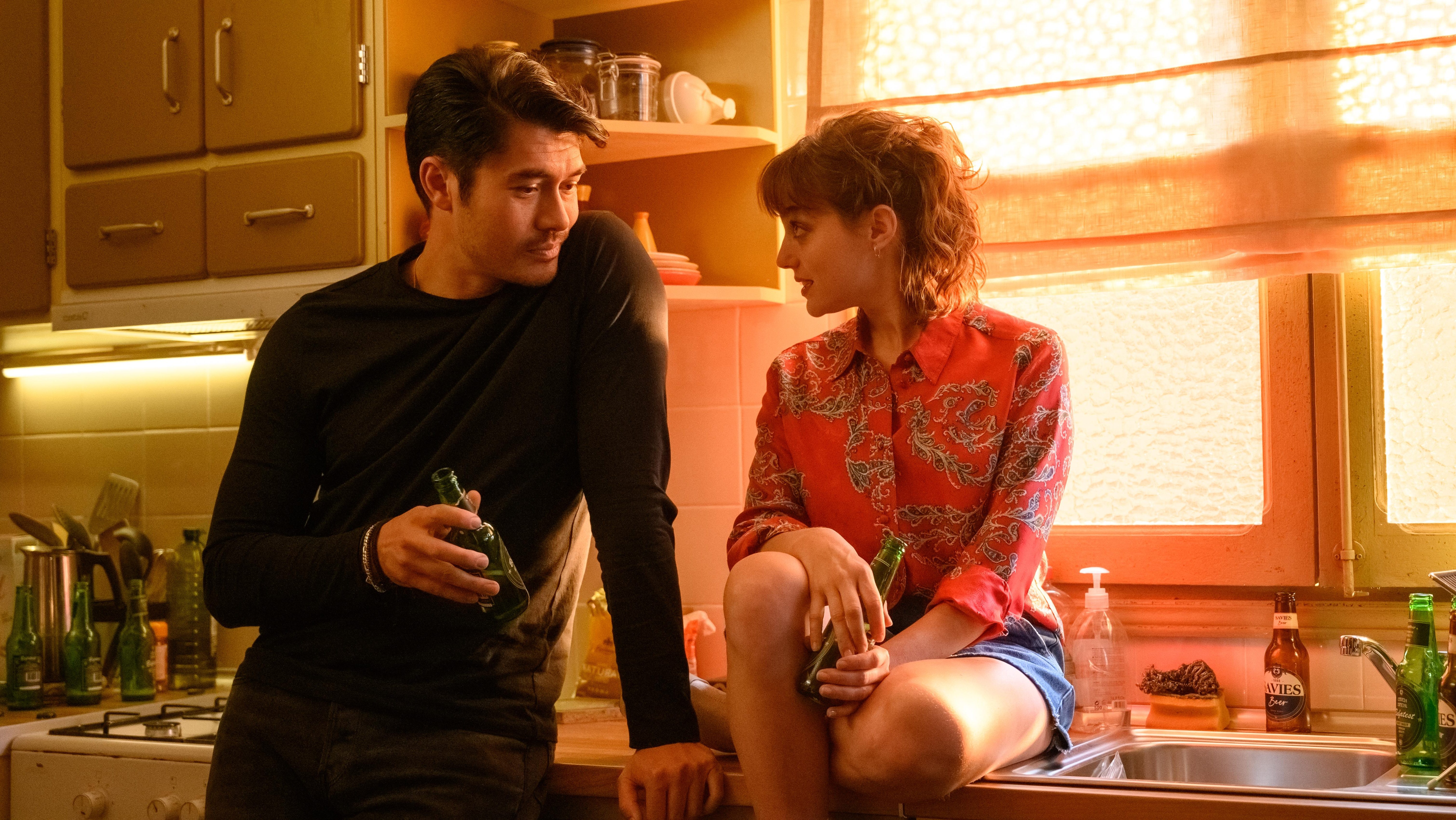
Directed by: Nacho Vigalondo
Written by: Nacho Vigalondo
Run Time: 1 hour 53 minutes
Despite his delightful rom-com beginnings, Henry Golding has more recently been exploring all things action. Between Snake Eyes (2021), Assassin Club (2022) and The Ministry of Ungentlemanly Warfare (2024) he’s been roughing things up rightly – but they haven’t all packed a punch. It’s somewhat of a relief then to see him return to his more comfortable, romantic roots with Nacho Vigalondo’s latest film, sci-fi romance Daniela Forever.
Struggling to cope after the sudden death of his girlfriend Daniela (Beatrice Grannò), Nicolas (Henry Golding) signs up for a secretive and experimental drug trial that allows him to lucid dream. However, when he goes against the instructions of the drug company, using the pill to continually revisit Daniela, his ability to distinguish between dreams and reality starts to blur.
Spanish filmmaker Nacho Vigalondo is certainly no stranger to abstract ideas, you only have to look to his previous film Colossal (2016) for evidence of this – where there’s parallels to Daniela Forever to be found too. While in Colossal Anne Hathaway’s character remotely controls a kaiju from the other side of the world (yes, it’s quite weird), here Golding’s Nicolas has the power to influence his own dreams. It’s a smaller, more personal angle, but both explore the characters’ capacity and desire to change and create.
Vigalondo’s own passion for direction is evident in his film’s undeniably cool concept – who wouldn’t want to be able to control their own dreams? He presents the idea with some nice artistic flourishes too. As Nicolas starts to dream and the possibilities of his mind expand, so too does the film’s aspect ratio. While the varying content of his dreams also provides Vigalondo the opportunity to become playful visually. However, this aesthetic expanse needed to extend also to the film’s thematic work, which sadly doesn’t reach its full potential.
It certainly provides some interesting thoughts on control, especially within the context of a relationship. Nicolas attempts to edit Daniela, only keeping the parts of her that he wants to make up this reimagined version of her. But of course as he edits her the Daniela he knew and love becomes less and less like herself – after all it’s her experiences that have made her into the person she is that Nicolas loves, even if he isn’t personally comfortable with them. This train of thought in Vigalondo’s screenplay is sound, however he doesn’t develop it or his characters enough for it to have the desired effect.
Daniela Forever doesn’t give audiences enough backstory to Nicolas and Beatrice’s relationship before prematurely launching into the film’s main idea. What exactly is Nicolas fighting to get back? Of course, audiences know he’s lost his girlfriend, but Vigalondo doesn’t show enough of the couple’s previous chemistry, he doesn’t explain just how much they loved each other and why this is such a great loss. On a very straightforward level death and loss is obviously sad, but Daniela Forever is in need of greater insight and investment into its central couple to fully appreciate the subsequent drama of its premise.
It’s frustrating too, because there are glimpses of this throughout the film. A humorous sequence that sees the pair take on two rather unique and fang-tastic monstrous identities in one of Nicolas’ dreams has all the fun of many rom-com favourites. While one bedroom scene that sees the couple really explore the possibilities of these lucid dreams offers more flirtatious fancy. However, these moments of romantic development are too few and far between, not featuring enough to adequately support the film over its bloated runtime.
It’s in these sporadic instances where Golding shines brightest too. His charm is reminiscent of his winning performances in romantic-comedies, Crazy Rich Asians (2018) and Last Christmas (2019), as this kind of role allows him to indulge in the silly, endearing qualities that make him such a desirable romantic lead. Unfortunately, when it comes to the more dramatic and emotional elements of this screenplay, Golding struggles. Whereas his co-star Beatrice Grannò is much more of a natural, excelling with these more complex requirements. However, finding herself playing very much second fiddle to Golding’s leading role, this deeper dynamic is never as strong as their surface-level romantic one.
The irregular feel to the couple’s chemistry and relationship is indicative of the film itself too. As Daniela Forever fails to really let its scenes breathe, too quickly moving onto the next before the previous can be properly appreciated. This creates an especially disjointed feeling that leads to problems with the pace and momentum, stopping audiences from ever fully settling into the full fantasy of its surreal narrative. Much like a dream you struggle to remember the next morning, ultimately, Daniela Forever doesn’t do enough to leave any lasting impression.
Star Rating: ★ ★
 Not Too Loud
Leave a comment