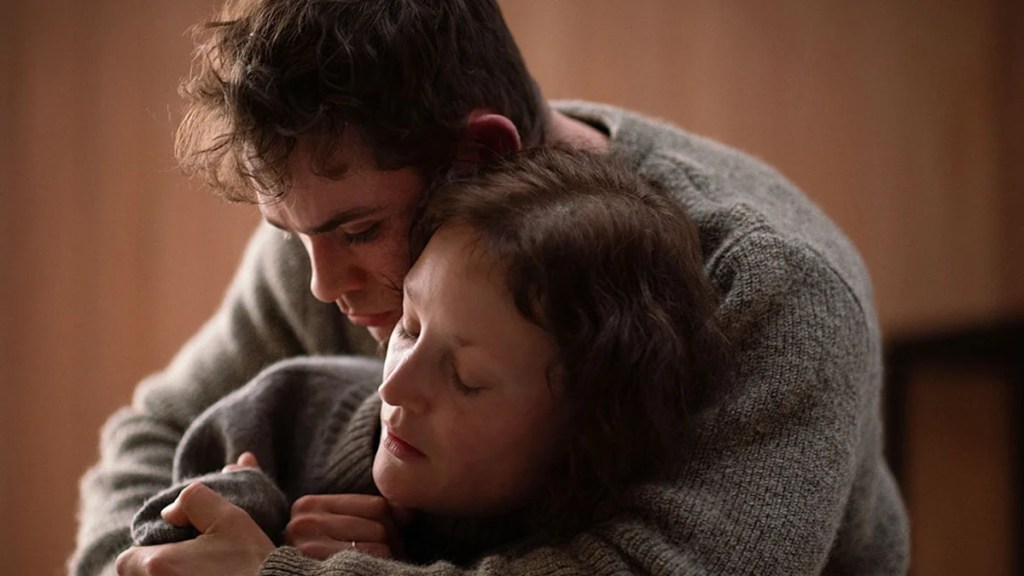
Directed by: Samuel Van Grinsven
Written by: Samuel Van Grinsven and Jory Anast
Run Time: 1 hour 40 minutes
The Stranger Things effect is one that can’t be denied. The immense popularity of the Netflix show has seen several of its young cast propelled to stardom – perhaps then, Dacre Montgomery is next? Admittedly, his post-show career has been a little quieter than some of his co-stars, but it’s hardly been unremarkable. The Broken Hearts Gallery (2020) for one, is a film of his that deserves much more love. And now he’s starring opposite Vicky Krieps, as together they lead Samuel Van Grinsven’s sophomore feature, Went Up the Hill.
The film follows Montgomery’s character Jack, as he journeys to a remote, mountainous region of New Zealand to attend the funeral of his estranged mother. While there, he meets her mourning widow Jill, played by Krieps, who persuades him to remain at the family home for a few more days. However, during his stay the spirit of his mother miraculously returns, inhabiting both Jack and Jill in turn whenever they sleep.
It’s a fascinating concept, and one that allows both of the main characters a chance to manoeuvre their grief. In Jill’s case it’s the loss of her wife, the love of her life, while in Jack’s, it’s the loss of potential, of a relationship he never had. The dreamlike quality of these nightly encounters proves particularly poignant, creating a sense that this spirit isn’t ready to move on yet – gone physically, but not quite content to depart entirely. It’s actually all very moving and the film’s delicate score coupled with the gentle performances really encourages audiences to let their guards down. It’s here, when viewers are at their most vulnerable, that Van Grinsven takes the drama in a distinctly disturbing direction.
It should come as no surprise that the director veers the story into darker territory. After all his debut, Sequin in a Blue Room (2019), did not shy away from exploring the more disquieting aspects of its main subject, gay hook-up culture. However, his debut managed this mood more successfully, as Went Up the Hill never seems to recover from its abrupt tonal shift. It certainly opens up the film to a range of new ideas and storylines, but its alteration in atmosphere and genre gearshift tips it towards a more tiresome trajectory.
The film’s initial study of grief becomes one of trauma, as it proceeds to repetitively demonstrate how we can become haunted by the upsetting experiences we endure and by the people who put us through them. And while it makes a number of entirely valid observations on the topic, the monotony of its plot after the promising first act creates an unmistakable drag that prevents Went Up the Hill from ever reaching the peak of its potential.
Nonetheless, the performances of both its leading stars are suitably layered and impressively versatile – the concept demands it of them, and each of them comfortably rises to the challenge. In fact, they do a considerable amount of work in keeping the film compelling for as long as the tedious script will allow for. Support from Sarah Peirse as Jack’s Aunt Helen is most welcome too, offering a rare additional perspective amidst the compact cast.
Yet, the uneven screenplay too often takes Went Up the Hill dangerously close to the edge, risking it falling off completely. In principle, it boasts an absorbing concept, but in practice, it lacks the intrigue or emotion to fully realise it. Black Mirror – in its heyday – could have told the same story, more effectively, and in half the time.
Star Rating: ★ ★

 Not Too Loud
Leave a comment