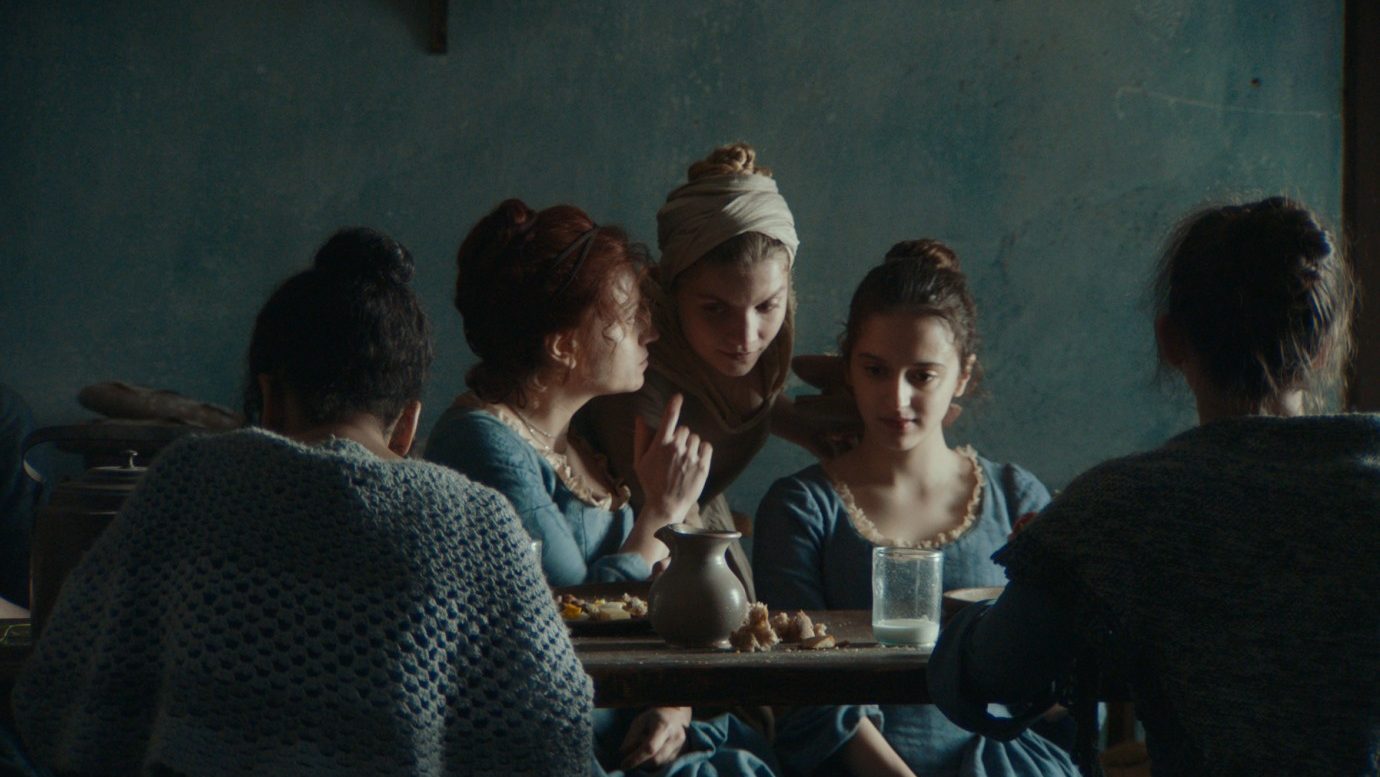
Directed by: Margherita Vicario
Written by: Margherita Vicario and Anita Rivarolli
Run Time: 1 hour 45 minutes
You only have to look at John M. Chu’s Wicked (2024) – and its ten Oscar nominations – to see how “popular” the movie musical has become once more. However, films like Kneecap (2024) have also shown how to feature music in less traditional ways. Both examples use music to tell stories and convey emotions, yet the latter also uses it to make a political statement and prompt social change. It’s this special musical power that Italian singer, actress and filmmaker Margherita Vicario taps into for her directorial debut, Gloria!
Set in a late 18th century Venetian music institute for orphaned girls, Vicario’s debut follows Teresa (Galatea Bellugi), a mute maid, who after discovering a brand new piano-forte in one of the school’s storerooms, encourages some of the girls to further pursue their own musical compositions. Meanwhile, the school’s strict director, Perlina (Paolo Rossi), attempts to prepare for an upcoming visit from Pope Pius VII, but is struggling to compose anything new for the concert that’s due to take place upon his arrival.
Perlina’s oppression of his students and staff is an offensive extension of the patriarchal system Vicario’s characters are trapped within. To spare themselves the brunt of Perlina’s entitlement, those girls who feature in his orchestra darn’t even suggest playing one of their own compositions opposed to his. While Teresa receives even harsher treatment, with Perlina threatening her position at the institute and – among many other sinister injustices – even imprisoning her on one occasion. As this deeply insecure and pathetic priest, Paolo Rossi delivers a proficient performance doused in desperation. He’s hellbent on remaining the most revered voice in the room, so it’s oh so satisfying when Teresa and the girls begin to amplify theirs.
The presence of musical elements is of course obvious from the film’s setting and plot, but in an early scene pre-title card, it’s quickly established just how much music will be the lifeblood of this film. While working in a busy courtyard Teresa can’t help but listen to all the sounds around her, weaving them together into a lively melody. The scene quickly takes on the sound and movement of some of Hollywood’s finest musicals, immediately energising the picture and foreshadowing the pivotal role music will play throughout. It’s an exciting promise of what’s to come, yet as Gloria! progress it never quite leans into the genre just as much as it does in this wonderful opening moment.
It’s a real shame, as more musical sequences like this could have remedied the minor pacing issues that occasionally arise later on. Nonetheless, the use of music throughout is one of the film’s biggest successes, because as well as directing, Vicario utilises her notable music experience by co-composig the film’s score. Together with Davide Pavanello, her compositions are largely classical, but in select moments they infuse this more symphonic sound with a distinctly contemporary beat. It pumps a wave of modernity through the film in a way that compliments the musical revolution its characters are carefully composing.
As Teresa and Lucia, Galatea Bellugi and Carlotta Gamba are certainly the most prominent of the female characters. They craft two very assured performances but there’s no absolute standout. Instead, and perhaps rather fittingly, the performances feel equally in tune with one another, creating a unified ensemble that confidently sings from the same hymn sheet. And through Gloria! Vicario carries on this same harmonious song, joyfully paying tribute to history’s female musical revolutionaries, still fighting to be heard.
Star Rating: ★ ★ ★
 Not Too Loud
Leave a comment