Directed by: Robert Eggers
Written by: Robert Eggers
Run Time: 2 hours 12 minutes
When it comes to remaking classic films, there’s always a hesitancy to embrace the idea of something new. This is particularly applicable to horror remakes, which are often remade far too soon, or simply to provide completely unnecessary English-language versions of already acclaimed international titles. Thankfully, this isn’t the case for Robert Eggers’ Nosferatu, which arrives over 100 years after the original film.
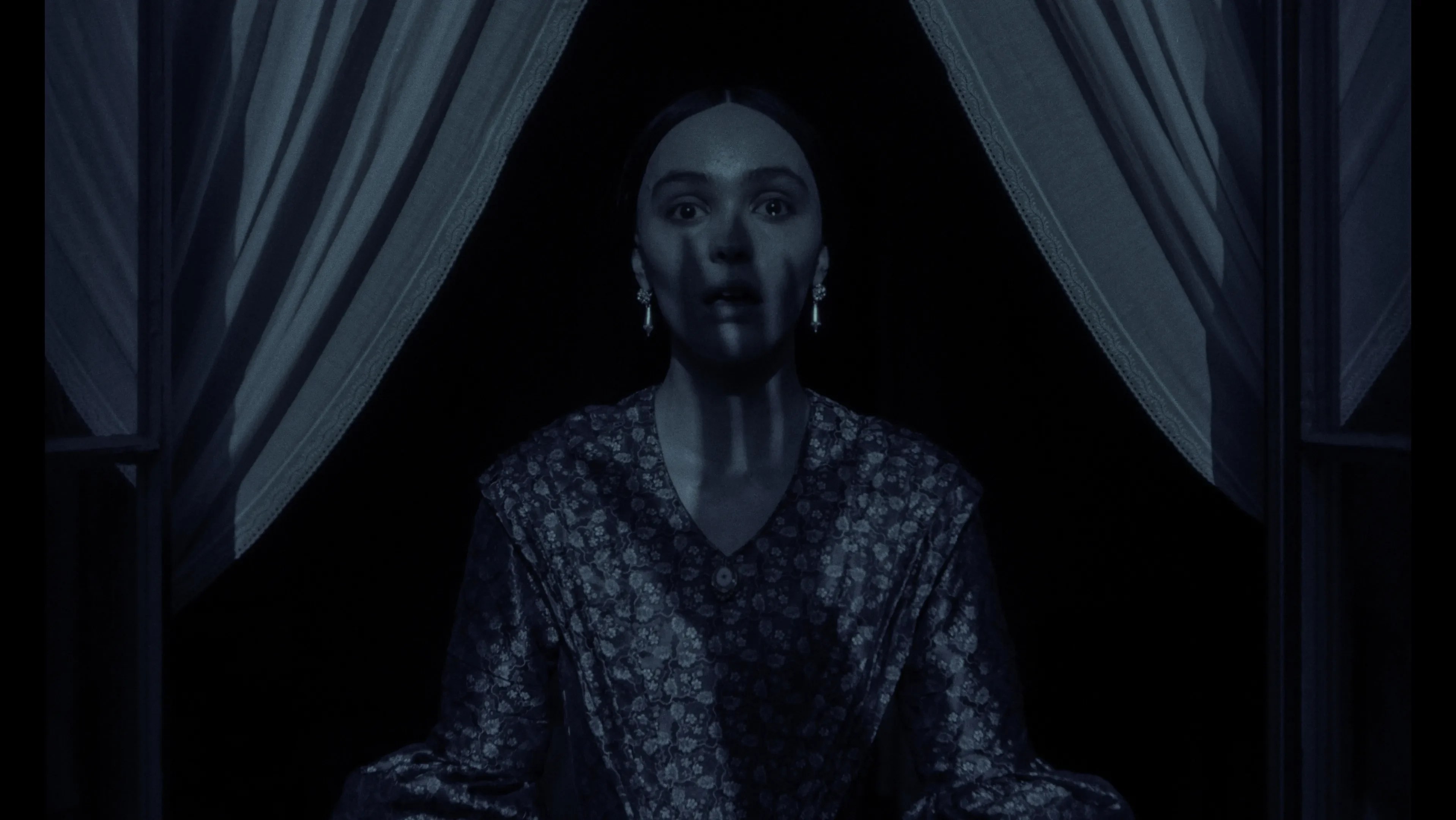
Similarly to F. W. Murnau’s 1922 silent version, Eggers’ Nosfertu is too based on Bram Stoker’s Dracula (1897). Set in 1830s Germany, young, enthusiastic estate agent, Thomas Hutter (Nicholas Hoult) is sent to Transylvania to secure the sale of a property to the mysterious Count Orlok (Bill Skarsgård). Meanwhile back at home, his new wife, Ellen (Lily-Rose Depp) is haunted by extremely vivid dreams and visions of the Count, which foresee him claiming her as his own.
Considering his proven track record with gothic horror – The Witch (2015) and The Lighthouse (2019) – Robert Eggers feels especially well-suited to reimagine such a renowned genre favourite as this. His love for the original story is evident, and through his detailed direction he conjures a haunting, but beautiful nightmare.
Nosferatu marks his fourth time collaborating with cinematographer Jarin Blaschke and editor Louise Ford, and their work here is their best yet. Blaschke’s cinematography is hypnotic as he seamlessly shifts his stationery camera into slow circular pans. Following his subjects and their fields of vision, rather than relying on excessive and unnecessary cuts, he expertly builds tension and atmosphere, giving the film its unnerving edge. While Ford’s truly masterful editing blends each scene into the next with some of the most impressive transitions the genre has ever seen. Under Eggers’ skilled direction the trio have crafted a truly stunning piece of cinema, raising the bar for what horror films can and should look like.
Subsequently, it’s easy to become enveloped by the dark, shadowy feel and appearance that much of the film is cloaked in. An aesthetic that matches Eggers’ eerie narrative of acknowledging and possibly submitting to evil. His screenplay doesn’t stray too far from the original, paying homage to the classic with much respect. Yet, his more focused exploration of Ellen’s melancholy is certainly a welcome addition, presenting intriguing parallels between it and its physical manifestation in the Count. But while largely compelling, his script doesn’t quite have the faultless flow of the film’s visuals, becoming ever so slightly sedated between its second and third acts. Although this is quickly overcome thanks to its at first thrilling, and then later poignant finale.
This emotional element manifests by way of the film’s accomplished ensemble – lead by Lily-Rose Depp – that act as new blood for the vampire classic. As Ellen she’s tasked with delivering an intensely physical performance and she captures her hysteria with conviction – evoking both horror and heartbreak in equal measure. Her onscreen husband, Nicholas Hoult has quite the time of it too. His initial meeting with the Count at his imposing Transylvanian manor proves particularly unsettling, and Hoult embodies this fear deftly. It’s a genuinely unrecognisable Bill Skarsgård as the horrifying Count Orlok who is the source of this terror. And while Skarsgård is no stranger to playing characters like these, his presence – assisted by the fantastic hair, makeup and costume work – commands the screen in a way fitting of Nosferatu’s terrifying reputation.
However, it’s actually the energetic and always entertaining Willem Dafoe as eccentric Professor Von Franz that entirely threatens to steal the show. Obsessed with the occult, he’s completely in his own lane here, and the film benefits from it enormously. Elsewhere, both Ralph Ineson and Simon McBurney offer reliable turns in smaller, but notable roles nonetheless. While it’s Aaron Taylor-Johnson who perhaps stands out as a weaker link. As Friedrich Harding, the Hutter’s wealthy friend, his stiffness could be put down to a curious character choice. Generously viewed as such, his work is satisfactory and does nothing to detract from the stellar collection of performances surrounding him. As the cast prove clearly compatible and collectively committed to Eggers’ chilling vision.
None of his characters are safe from Nosferatu’s evil as it gradually creeps up and touches each of them, yet – and rather refreshingly, for a horror film – none are disposable. His meticulous approach to telling this story allows for detail and depth. It sees Eggers reach into the most monstrous of nightmares and drag them into the light, ultimately making his Nosferatu just as dazzling as it is dark.
Star Rating: ★ ★ ★ ★



 Not Too Loud
Leave a comment