Directed by: Jonás Trueba
Written by: Jonás Trueba, Itsaso Arana and Vito Sanz
Run Time: 1 hour 54 minutes
Break-up movies tend to find themselves in one of two major categories. The first of which is home to the more serious relationship dramas, such as Derek Cianfrance’s Blue Valentine (2010) or Noah Baumbach’s Marriage Story (2019). Those in the second category usually have more in common with classic romantic-comedies, often seeing a recently dumped protagonist seek out a new relationship, like Steve Carrell in Crazy, Stupid, Love (2010) or Cameron Diaz in The Holiday (2006). However, with Jonás Trueba’s latest film, The Other Way Around he attempts to do something entirely different to both.
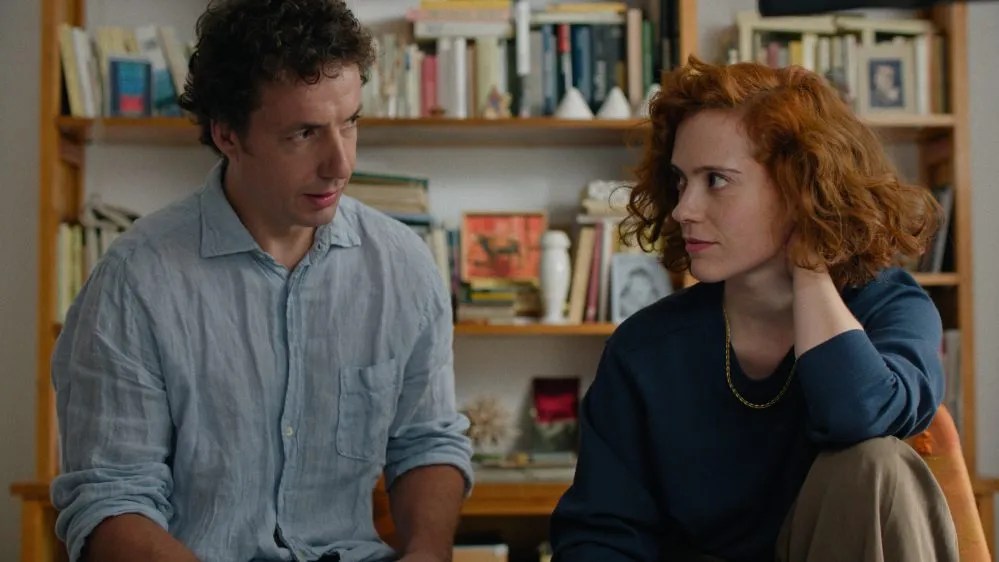
After Madrid-based couple of 14 years, filmmakers Ale (Itsaso Arana) and Alex (Vito Sanz), mutually end their relationship, they attempt to break-up as amicably as possible. With this in mind, and inspired by an idea they first heard from Ale’s father (Fernando Trueba), they decide to throw a party celebrating their separation, inviting all of their friends and family – even if they’re not quite sure whether to believe them or not.
It’s certainly an original premise, and one with plenty of possibility for humour. The looks of befuddlement on the faces of friends and family members as the soon-to-be ex-couple announce their split are suitably amusing. However, this is the problem with The Other Way Around, as this amusement never quite manages to develop into anything more than that, failing to realise the potential hilarity of its intriguing concept.
Although, Trueba’s film is undeniably playful. Its title even manifests itself in the film in several different ways. Many scenes actually begin at their end point, before then skipping back to the start and playing out as normal. Similarly, in an art class Alex is seen taking part in throughout the film, he literally paints on his canvas the other way around. Details like these do reinforce the unique perspective the couple are approaching their break-up from, but also begin to feel ostentatious.
Perhaps the most meta of its features though is the film that Ale is seen editing throughout, one that seems to consist of scenes from the couple’s actual life. The Other Way Around and this film within morph together, at times making it hard to decipher where one begins and the other ends. Ale does comment in the film’s opening scene that the concept of a break-up party would be a good idea for a film, but that it wouldn’t work in real life – a distinction that becomes increasingly difficult to make as the film progresses.
It’s ironic, and maybe intentional, then, that in one scene where Ale seeks the feedback of her friends regarding the first cut of her film, the negative critiques she receives could also be applied to The Other Way Around. One friend suggests that her film is repetitive, and the exact same can be said for Trueba’s work. Even is this is an attempt to be self-aware, it doesn’t detract from the fact that The Other Way Around is indeed repetitious, and in a way that eventually breeds boredom.
By the time the film eventually enters its final act, all the charm of its quaint premise has well and truly worn off. Losing its focus and any sense of sincerity, Itsaso Arana and Vito Sanz’s compelling cinematic company is no longer enough to keep the film engaging. Instead, the monotony and pretension of it all will likely have you willing the couple to simply get on with it, and just break-up already.
Star Rating: ★ ★
 Not Too Loud
Leave a comment