Directed by: Paul Kennedy
Written by: Paul Kennedy
Run Time: 1 hour 22 minutes
Within the last decade alone we’ve seen two fairly prominent film adaptations of William Shakespeare’s famous tragedy. Michael Fassbender previously took on the title role in Justin Kurzel’s critically-acclaimed Macbeth (2015), while more recently Denzel Washington portrayed the character in Joel Coen’s Oscar-nominated The Tragedy of Macbeth (2021). These are only two examples of the countless adaptations and reimaginings we’ve seen over the years. But the latest to join this ever-expanding list – Paul Kennedy’s Dead Man’s Money – is unlikely to resemble any adaptation you’ve seen before.
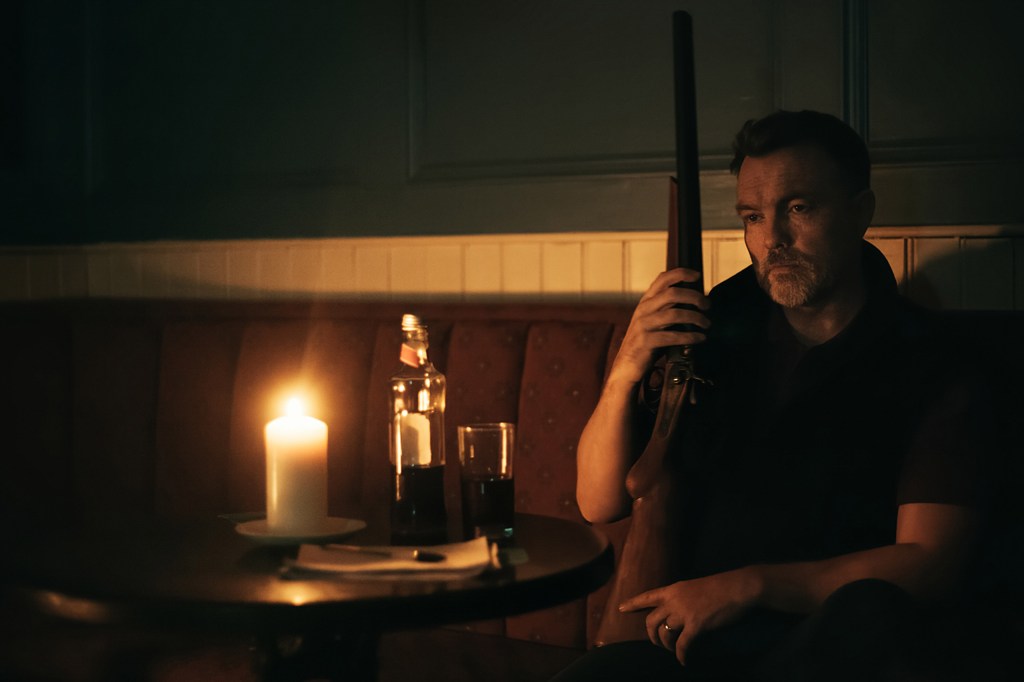
Rather than the trio of Scottish castles that the original play takes place in, Kennedy’s film is set in a singular pub, Kenny’s Bar in an unnamed Northern Irish village. His film, which is more inspired by, rather than a direct adaptation of Macbeth, follows Young Henry (Ciarán McMenamin) and his wife Pauline (Judith Roddy), who together run the aforementioned pub. However, when the couple learn that their inheritance from Young Henry’s uncle, Old Henry (Pat Shortt) may be at risk due to his new relationship with the town’s infamous gold digger, the Widow Tweed (Kathy Kiera Clarke), they hatch a dastardly plan to secure it.
An Irish adaptation of Macbeth is a really fun, intriguing idea, but sadly Kennedy’s vision struggles with its tone from the offset. The film attempts to blend its serious, straight-faced interpretation with a more comedic take running alongside it. Unfortunately, the results end up closer to a Shakespearian spoof than anything more credible. It feels like if BBC Northern Ireland’s Give My Head Peace or Channel 4’s Derry Girls were to parody the play, but not as successfully as either of these shows would likely have managed.
However, where it does succeed is in its undeniable sense of place. Its colloquial dialogue is excellent and will certainly play well to home crowds. For audiences further afield, subtitles may well be required. This element undoubtedly shows the heart behind the project too, something that’s further evident in its cast of local talent. It’s a shame, then, that the script doesn’t showcase their abilities more assuredly.
Those left largely with the more dramatic material – Pat Shortt as charming Old Henry and Gerard Jordan as ex-IRA hardman Gerry – fare all the better for it. Whereas Ciarán McMenamin and Judith Roddy, the respective Macbeth and Lady Macbeth here, have to juggle the screenplay’s uneven tone, and as a result aren’t as consistent. McMenamin in particular struggles, rarely finding the balance between his dramatic delivery and comedic timing – admittedly a challenging task when it’s nowhere to be found in the script either.
It’s unsurprising then, that as the Widow Tweed, Derry Girls star Kathy Kiera Clarke emerges as the standout. While she’s on screen the film’s tone briefly clicks into place. One sequence detailing the deaths’ of her three husbands proves particularly amusing and could be lifted straight from any of the funniest episodes of Father Ted. Perhaps a feature length version of her marital strife would have made for a more cohesive and entertaining watch.
Because as it stands, the tonal confusion makes the film’s moments of drama feel completely out of place, becoming tedious right up until Dead Man’s Money awkwardly petters out. Its claustrophobic setting of Kenny’s Bar – in reality The Ivy in Newtownards – doesn’t help things either. While the film’s use of the limited space is admirable, the lack of variety in both setting and visuals doesn’t give the audience enough to engage with, creating a sense of agitation rather than immersion.
Kennedy’s later attempts at injecting some horror only further removes the audience too. He’s no stranger to the genre, having previously co-written the script for found-footage horror, The Glenarma Tapes (2022). Yet, his handling of the tacked-on genre elements here feels like a distinct afterthought. His introduction of them so late into the film gives them an indisputable shock value, but this alone can’t make up for their poor conception or execution.
So whether it’s this awkward inclusion of horror, the unvaried setting, or even the temptation to unfairly compare it to other, more successful takes on Macbeth, for whatever reason (it’s mostly the muddled script) Dead Man’s Money simply just doesn’t work. However, it is worth noting that it does bravely open with a direct quote and mention of the Scottish play itself, so perhaps the kinder option would be to put its tragedy down to nothing more than Shakespearian superstition.
Star Rating: ★ ★


 Not Too Loud
Leave a comment