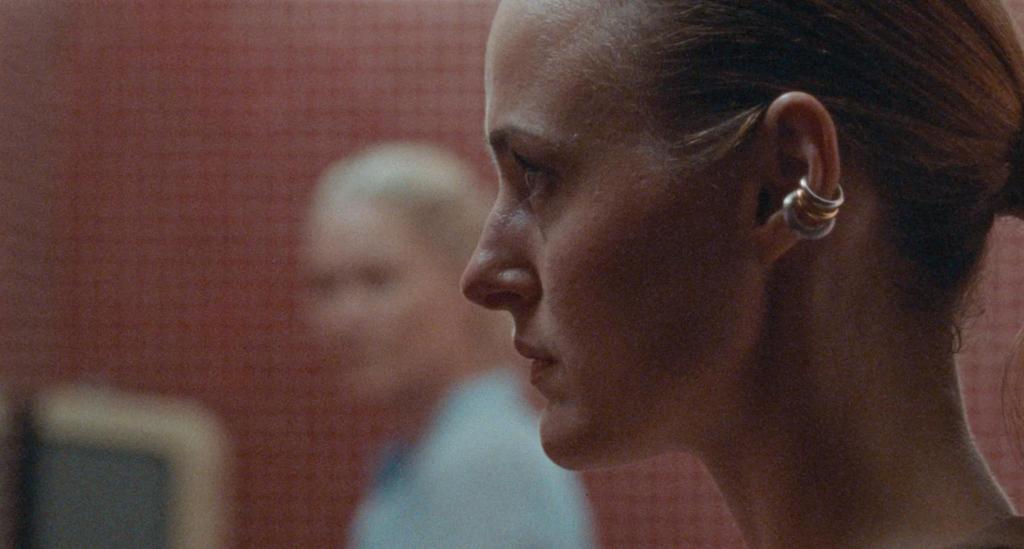
Directed by: Halfdan Ullmann Tøndel
Written by: Halfdan Ullmann Tøndel
Run Time: 1 hour 57 minutes
Renate Reinsve is probably best known for her breakout role in Joachim Trier’s The Worst Person in the World (2021). Although since this memorable turn she has gone on to star in a number of other notable productions as well, Aaron Schimberg’s A Different Man (2024) and Apple TV+ series Presumed Innocent perhaps being the most prominent. Now, adding to her already impressive CV, she’s the lead in the Caméra d’Or-winning Armand, the debut from Halfdan Ullmann Tøndel, grandson of renowned Swedish filmmaker, Ingmar Bergman.
His film follows the aftermath of an altercation between two six-year-old school boys, as their parents are called in to try and figure out what really happened. Elizabeth (Renate Reinsve) is a single mother, and the parent of the accused child, the titular Armand. His alleged behaviour towards one of his classmates, Jon, has deeply concerned his parents, especially his mother, Sarah (Ellen Dorrit Petersen). Together with the help of the boys’ teacher, Sunna (Thea Lambrechts Vaulen), they must try and find a resolution.
The imposing school building that the film almost exclusively takes place in certainly provides an uncomfortable setting for the central investigation to unfold in, presenting unease and mystery around the corner of every classroom. The corridors are long, dark and uninviting, almost like they aren’t meant to be seen after normal school hours; there’s a broken fire alarm that keeps blaring uncontrollably; and there’s a powerful heat in the air, one that the school’s air conditioning is struggling to adequately combat. These location details heighten the dramatic tension that naturally spills out of the screenplay, however Tøndel’s film isn’t content just to be a straightforward drama.
Armand is ever-changing, starting out as a drama with – given the rather serious allegations – a surprising amount of comedy weaved throughout it. However, it quickly takes on a more serious tone as it veers into its moral quandary. Later it even introduces some more surreal moments that continue to expand the film’s repertoire of genres and tones. Its constantly evolving nature certainly keeps things engaging, but also makes the picture feel slightly disjointed, in places interfering with the film’s pace. Arguably, with the main premise already proving interesting enough on its own, it maybe could have done without these subsequent, abstract deviations.
Armand initially manages to be this compelling thanks to Reinsve’s stirring leading performance. Eizabeth is backed into a corner and expected to reveal so much of herself to explain her son’s alleged behaviour. It’s invasive and Reinsve demonstrates the young mother’s disgust and disbelief with vigour. She creates a firm stance within Elizabeth, who stands up for herself and her son with unshakable confidence. However, Reinsve of course also adds further nuance to the character, gradually conveying the emotional turmoil of her personal life. This is seen throughout the film but most clearly in one extended sequence of awkward, uncontrollable laughter that shows both Reinsve’s talent as an actor and Tøndel’s thoughtful character writing – effectively planting a seed of doubt regarding Elizabeth’s moral standing.
The supporting cast demonstrate a similar school of quality. As Jon’s mother, Ellen Dorrit Petersen is unassailable, determined to get justice for her child no matter what. Her steely glare cuts through Elizabeth’s initially flippant responses and creates an intense rivalry between the pair. Trying her best to keep the peace between the two mothers is Thea Lambrechts Vaulen as the somewhat bewildered junior teacher tasked with resolving the impossible situation. Her performance is both comedic and endearing as she tries her best to navigate such a tricky situation. While the remaining ensemble support these main players well.
With such an accomplished cast and absorbing script in place Armand, at first, offers an engrossing study into how educational institutions and society as a whole deal with serious accusations. At times it even feels reminiscent of fellow Nordic drama, The Hunt (2012). Yet not content to settle for the plaudits it achieves in its fruitful first half Armand attempts to develop into something greater, but instead digresses too far from its pre-established tone and starts to unravel. Ultimately Tøndel indulges in a bit too much daydreaming and not enough focus, but unsurprisingly, it’s an A+ for Reinsve.
Star Rating: ★ ★ ★



 Not Too Loud
Leave a comment