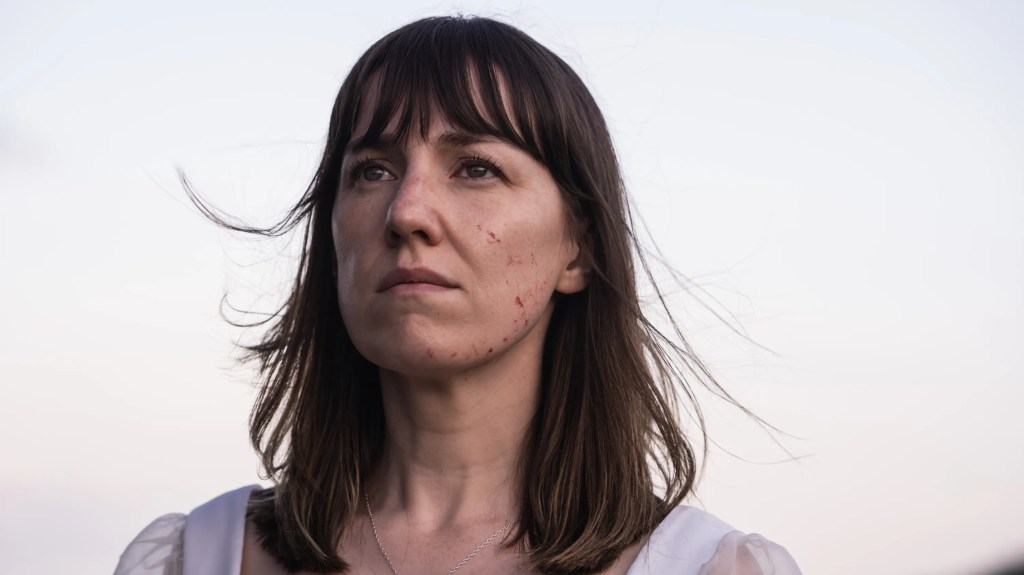
Directed by: Aislinn Clarke
Written by: Aislinn Clarke
Run Time: 1 hour 43 minutes
In her career to date, writer-director Aislinn Clarke has enjoyed a close relationship with both the genre of horror and the Irish language. Her feature debut, The Devil’s Doorway (2018) was a found-footage horror taking place in a Magdalene laundry, while she would later go on to pen the screenplay for Northern Ireland’s first ever Irish language film, Damian McCann’s Doineann (2021). Now, with her sophomore film, Fréwaka, she’s brought the two together, delivering one of the first ever Irish language horror films.
Fréwaka follows Shoo (Clare Monnelly), a young carer who in the wake of her mother’s death takes on a new job. She’s assigned the care of Peig (Bríd Ní Neachtain), an elderly woman who lives alone in a large remote country house. Peig is extremely wary of Shoo to begin with, exhibiting the paranoia that Shoo has been warned about, both by her co-workers and from Peig’s superstitious neighbours. However, as the pair spends longer together, Shoo starts to realise that Peig’s fears about evil intruders getting into the house via her menacing red cellar door, might have more weight to them than she first thought.
Much of the horrors to be found within the confines of Peig’s creaky, old, horseshoe-laden home are actually firmly based in reality, with both of its residents battling their own personal demons. Shoo is dealing with the death of her mother, who audiences quickly learn she was estranged from, while Peig is haunted by the trauma of her past, centred around her wedding night, depicted in the film’s energetic opening sequence.
Described by Clarke as more of a dramatic horror, Fréwaka uses the very real places that her characters’ terror is born out of to enhance the film’s atmosphere and dramatic tension. And it’s in these moments, that acutely draw on these women’s real-life experiences, that the film is at its most convincing.
Where Fréwaka ever so slightly begins to falter, though, is in some of its less subtle attempts at horror. A house visit from one of Shoo’s superiors plays out in particularly hammy fashion, feeling in direct conflict with the film’s pre-established tonal restraint. Although, no matter the scene, whenever Die Hexon’s imposing score is in full effect there’s no escaping the film’s horror. As amidst all of the film’s more dramatic moments, it reminds audiences of the imminent danger facing both characters and gives Fréwaka the distinct surge of trepidation that it needs to succeed – especially in the film’s thrilling third act.
It’s here where Clarke’s carefully-considered screenplay also really comes into its own, delivering a satisfying synchronisation of the characters’ stories. This is realised by the committed performances of its two main actors. Both Clare Monnelly – in a welcome reunion with Clarke after Doineann – and Bríd Ní Neachtain tackle the script with much skill. And through Clarke’s attentive guidance, together they effectively portray their characters’ ever-developing relationship, from its fractious beginnings to its intense climax.
Yet, despite how much the story progresses it never strays too far from its origins. As inspired by the folk stories and oral histories Clarke was told as a child, Fréwaka is an unmistakably Irish horror film. It’s steeped in the history of its setting and taps into much of Ireland’s painful past. It will most certainly garner comparisons to other folk horror highlights, perhaps most obviously Robin Hardy’s The Wicker Man (1973), but Fréwaka is so grounded in its specific sense of place – the film’s title literally means “roots” – that it confidently carves out its own space in an already crowded subgenre.
Star Rating: ★ ★ ★
 Not Too Loud
Leave a comment