Directed by: Mike Leigh
Written by: Mike Leigh
Run Time: 1 hours 37 minutes
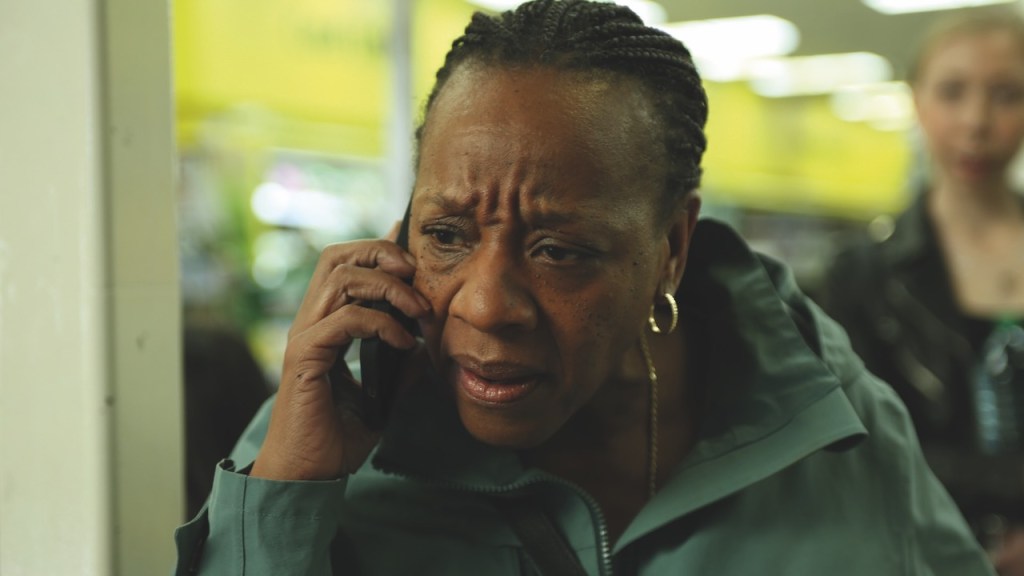
With a career spanning over 50 years, it’s a real achievement that the films of British writer-director Mike Leigh have remained of such a consistent high quality. His newest feature, Hard Truths, explores the lives of a middle-aged woman, Pansy (Marianne Jean-Baptiste) and her sister Chantal (Michele Austin). Pansy is a tormented mother who lashes out at every possible opportunity. Whereas her sister Chantal, a hairdresser and single-mother of two, has a more positive outlook on life, and is one of the only people that Pansy shares a genuine bond with. Over the course of a week leading up to Mother’s Day, Leigh’s intimate drama explores the sisters’ relationships as they come to terms with events from their past.
Leigh is a personal and intimate director, building close relationships with actors that have led to him having several frequent collaborators. Hard Truths is no different, as he reunites with Secrets & Lies (1996) co-stars Marriane Jean-Baptiste and Michele Austin. Together they have workshopped their roles and created natural and improvised developments for their characters. This attention to detail greatly adds to the film’s realism, as does the work of the crew, with the use of props in scenes portraying mundane activities such as Pansy’s constant cleaning adding that little bit more context to the characters and their lives.
Although, it’s always a challenge when a film’s lead character isn’t particularly likeable, which in the case of Pansy, is a serious understatement. On the surface she borders on loathsome, as a character who manages to find fault with even the smallest of issues and the people around her. She points them out at every possible opportunity too, essentially becoming every customer service employee’s worst nightmare.
Miraculously, Jean-Baptiste always manages to keep the audience invested in Pansy by giving one of the year’s most layered performances. She provides a surprising amount of intentional comedy through the delivery of various insults and long tangents about the annoyances Pansy encounters. Thankfully these scenes never approach, nor cross the line of cartoonish, due to each moment of humour containing an underlying feeling of tragedy. From the film’s opening moments, it’s clear that Pansy is an emotionally-tortured woman who resents life for legitimate reasons, which gradually come to light as the film progresses.
Conversely, as Chantal, Austin provides some much-needed joy, giving a performance that radiates optimism and positivity. In contrast to Pansy’s estranged relationship with her son, Chantel shows unconditional adoration for her two daughters and the scenes in which they interact give off such infectious energy that lifts the mood of an otherwise downbeat story.
Her relationship with Pansy is a classic chalk-and-cheese pairing, but the improvised conversations between the two characters involve great chemistry and give their sisterhood more authenticity than most other cinematic sibling relationships. Therefore it’s a shame that there isn’t much of an arc for Chantal, as the character rarely appears after a pivotal scene involving the whole extended family.
In fact, the film in general leaves a few too many loose ends hanging, despite the closing moments being effective in the moment. At only 97 minutes, the film doesn’t outstay its welcome, but it could have had more of a lasting impact and a stronger sense of closure if some characters had a scene or two more.
However, Leigh’s collaborative nature doesn’t end with his cast, extending also to his crew with cinematography by Dick Pope and music composed by Gary Yershon. Pope’s camerawork is simplistic by design, using static shots to make the audience feel like eavesdroppers on the characters’ most private and vulnerable moments, and only using movement in shots that don’t feature any of the principal actors. The music is similarly understated, making use of subtle string instruments that are used sparingly so as not to overshadow the writing and performances that already showcase the intense emotions the film wants to present.
Ultimately, Hard Truths presents itself as a great example of a film where everyone in the cast and crew collaborate to create a singular cohesive vision. Despite a conclusion that may leave some feeling unfulfilled, it’s another hard-hitting entry in Mike Leigh’s legendary filmography. With excellent performances, a clear understanding of its main characters and naturalistic filmmaking, it’s a tragic story about family relationships that’s sure to connect with many.
Star Rating: ★ ★ ★ ★
 Not Too Loud
Leave a comment