Directed by: Roshan Sethi
Written by: Eric Randall and Madhuri Shekar
Run Time: 1 hours 36 minutes
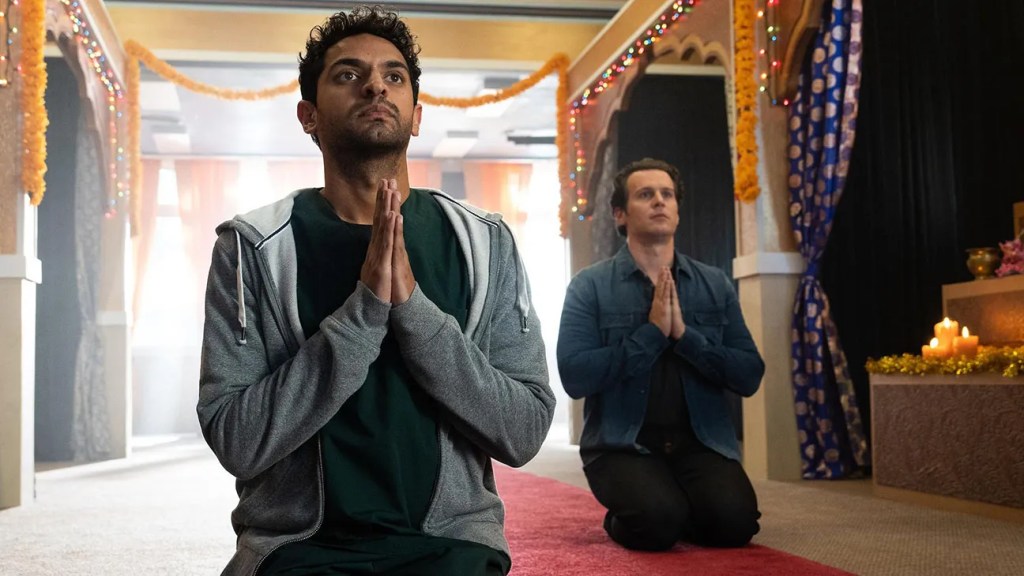
Over the last decade or so Karan Soni – across both film and television – has become one of the most reliable comedic character actors of his time. He’s probably best known for his work in the Deadpool films as taxi-driver Dopinder, or more recently as the voice of Spider-Man India in Spider-Man: Across the Spider-Verse (2023). However, amongst his impressive roster of supporting parts there are leading roles to be celebrated too; in Roshan Sethi’s enjoyable covid rom-com 7 Days (2021) for one. And it’s through this same actor-director pairing that new queer rom-com, A Nice Indian Boy sees Soni in a leading role once more.
He plays Naveen, a young doctor from a traditional Indian family who meets and falls for freelance photographer, Jay (Jonathan Groff). After a whirlwind romance the couple gets engaged, but as they begin to plan their big day they are met with some unwelcome intervention from Naveen’s family, who have their own ideas of what the wedding should entail.
A Nice Indian Boy has all the genre tropes that you might expect from a film that uses a character’s heritage or culture as a point of conflict. In this instance it’s Naveen’s traditional Indian family, although they’re really quite liberal he reassures Jay in one scene – they do watch OUTtv after all. The film isn’t a coming-out story though, as his family already know he’s gay. But while his mother (Zarna Garg) perhaps tries a little bit too hard to prove her acceptance towards him, conversely there’s a reluctance from his father (Harish Patel) to fully embrace Naveen for who he truly is. The film is never unkind though, being careful to explore the perspective of Naveen’s parents fairly and to celebrate their vibrant culture while doing so.
As Naveen, Soni is an absolute delight. He has an effortless, endearing charm which should really see him leading rom-coms like this for years to come. He excels in the romantic, comedic and dramatic elements of the script creating a loveable lead character, making it vividly apparent as to why Jonathan Groff’s Jay would fall for him so quickly. Unsurprisingly, the naturally charismatic Groff is similarly well-suited to his role and with such likeable casting in place, Sethi’s film has no problem getting audiences on side.
The story is told through five different chapters, but A Nice Indian Boy is a book of love that could have benefited from a few extra pages. As while there’s undeniably some cute chemistry between Naveen and Jay, the screenplay by Eric Randall and Madhuri Shekar, rarely gives their relationship much depth. Their romance isn’t unconvincing, but it doesn’t quite reach the heights of the big love that the film mentions; that love that would make audiences wholeheartedly believe that Naveen and Jay absolutely, unquestionably, against all the odds belong together.
Despite this, the film manages to get away with it, as A Nice Indian Boy is actually less about the central couple and more about Naveen’s relationship with his family, who after the announcement of his engagement begin to reflect on their own relationships. His sister, Arundhathi (Sunita Mani) must address the unhappiness in her new marriage. Whereas, Naveen’s parents start to express their fears and concerns, considering their own marriage, as well as the generational differences between themselves and their children. It’s through these questions and conversations that the film’s heartwarming message of love and acceptance shines through most brightly.
The joyous third act is where A Nice Indian Boy is at its most inviting though. Unleashing the full potential of its uplifting spirit in these closing moments, the film offers a moving, funny and jubilant finale to the admittedly rather conventional rom-com that came before it. So while, as a whole, it doesn’t necessarily go off without a hitch, this emotive conclusion paired with Karan Soni’s undeniable appeal as a rom-com lead is a marriage made in movie heaven.
Star Rating: ★ ★ ★


 Not Too Loud
Leave a comment