Directed by: Ben Taylor
Written by: Jack Thorne
Run Time: 1 hours 55 minutes
Women’s bodies have always been unfairly policed. Whether it’s restriction to abortion services, misogynistic ideas of what clothing is deemed acceptable, or most recently schools demanding proof of periods to allow sick days, the female body has and continues to receive unfair scrutiny that silences women’s voices. This too was the case during the development of in vitro fertilisation (IVF) in the 1960s and 1970s – the subject of new Netflix drama Joy, from director Ben Taylor.
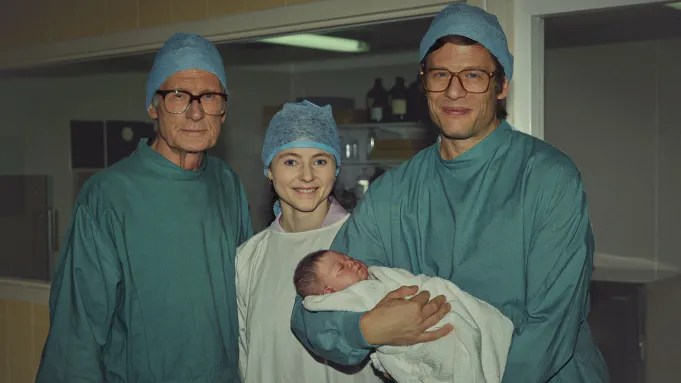
Taylor’s film follows the medical endeavours of nurse Jean Purdy (Thomasin McKenzie), scientist Robert Edwards (James Norton) and surgeon Patrick Steptoe (Bill Nighy). It charts their attempts to make IVF a success and therefore a viable option for those parents who cannot conceive naturally, inherently combating infertility.
Jack Thorne’s screenplay approaches the story in a very straightforward manner, methodically detailing the years the trio spend trying to develop IVF. As well as documenting their research, Joy gives a good summation of the different attitudes held towards it at the time, including political opposition and the inevitable religion vs. science debate. It’s all very competently done, but narratively it never does anything that the audience can’t anticipate two or three scenes previously. Although, sometimes it’s ok for stories to be straightforward – and this is most definitely the case for Joy.
The cast assembled here is wonderful. James Norton is endearing as the eager, but easily frustrated Cambridge scientist devoted to his cause. Bill Nighy is reliable as ever as the experienced surgeon, who also manages to inject a lot of comedy into the proceedings. While Thomasin McKenzie confidently leads as the determined nurse, sensitively tapping into the story’s more human elements. They create a very watchable group that are pleasant company throughout, ultimately making this simple story all the more engaging.
There’s great support outside the main trio too. Tanya Moodi stars as the firm but fair Matron at Oldham hospital. Whereas Joanna Scanlan plays Jean’s religious mother, offering a personal conflict for her, as she is forced to choose between her spirituality and her science. There’s also a small, but really lovely turn from Derry Girls‘ Louisa Harland as one of the original group who volunteer their bodies to help with the research. If anything, more time spent with these women would have strengthened the film.
Nonetheless, Joy is a story predominately about its lead character Jean and her contributions to such a remarkable scientific breakthrough. Jean’s personal story gives the film much of the raw emotion that runs through its cinematic veins so abundantly. As while Taylor’s film is unmistakably by the numbers, every beat of its script has such authentic feeling behind it that compensates for its rather conventional presentation. Its subject matter is a naturally moving one and the film recognises this, generating many powerful scenes throughout.
Perhaps what it does best though isn’t its depiction of how the team developed IVF – while still perfectly informative – but rather, why they knew it was just so important to do so. It’s a film about giving women choice and Joy does well to deliver this message in such uncomplicated, entertaining and accessible fashion.
Star Rating: ★ ★ ★




 Not Too Loud
Leave a comment