Directed by: Marcelo Caetano
Written by: Marcelo Caetano and Gabriel Domingues
Run Time: 1 hours 47 minutes
For most queer people the idea of chosen family is one that they’re likely familiar with, even if they don’t need it personally. It’s something that can be relied upon in varying degrees depending on individual circumstances. However, in Marcelo Caetano’s Baby, the writer-director provides an example of when it becomes a complete necessity.
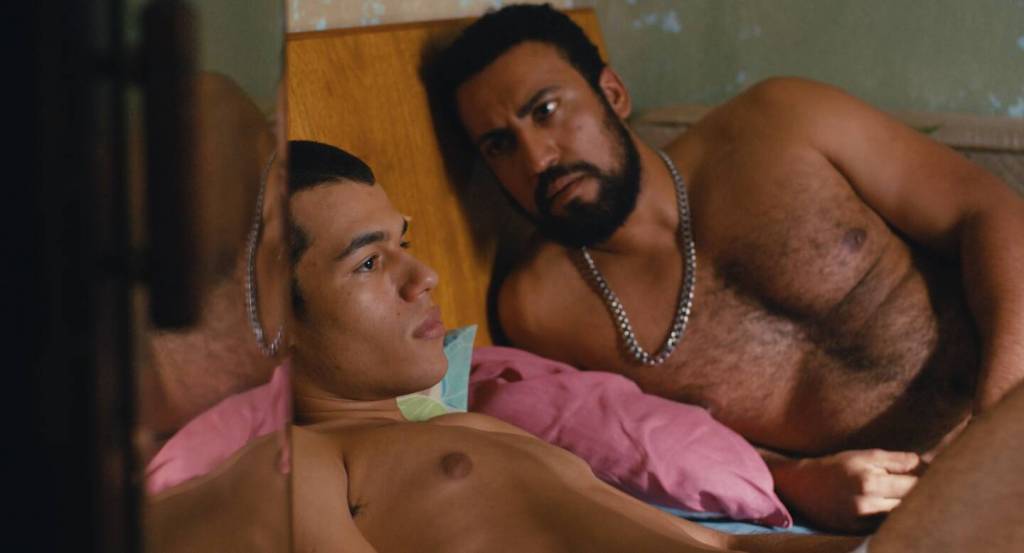
Having just been released from juvenile prison and discovering that he’s been abandoned by his parents, eighteen-year-old Wellington (João Pedro Mariano) – who later takes on the name “Baby” – must put his trust in the various men that he encounters on the São Paulo queer scene. At first things look promising as he reconnects with some old friends. Voguing and kiking on the streets at night they appear to be just the safe haven he needs. Although after an older escort, Ronaldo (Ricardo Teodoro) swiftly takes him under his wing, Baby quickly falls into an unstable lifestyle of sex work and drug dealing.
The story at the heart of Baby is not dissimilar to the one told in Camille Vidal-Naquet’s Sauvage (2018), in which a young sex-worker remains hopeful at the prospect of finding love amidst his difficult circumstances. Caetano’s film is one full of hope too, but it’s never naive. It displays the very real dangers and risks that come with Baby’s new lifestyle, whilst always being careful not to condemn his line of work. Instead, Caetano and writing partner Gabriel Domingues repeatedly demonstrate what little choice Baby has when seeking the safety and security he so deserves, but is continually denied.
This kind of narrative can run the risk of becoming repetitive, and while in rare moments the pace can lag, João Pedro Mariano’s leading performance prevents it from developing into any significant monotony. He embodies Baby’s willingness to love and be loved so naturally, easily endearing the audience to him and his quest to find somewhere to feel at home and truly belong.
His co-star Ricardo Teodoro succeeds too at portraying Ronaldo and his differing worldview, as he carries with him the responsibility of providing for a son. Yet while their priorities greatly differ there’s a moving connection between Baby and Ronaldo that bridges the gap of their respective circumstances. One that Mariano and Reodoro’s impressive chemistry ensures is always palpable.
The film’s presentation of the larger queer context that this relationship exists in is informed and unafraid too, touching on many aspects and experiences of queer culture – both good and bad. Discussions of generational differences, loneliness and homophobia all feature in the film’s screenplay, yet it refuses to feel sorry for itself. As it’s in seemingly throwaway moments, such as Ronaldo’s queer family lovingly sitting doing each other’s hair, that Baby has the most to say about queer people and their relationship to family – biological and chosen alike.
Featuring these pockets of love and affection amidst Baby’s unquestionably challenging post-prison life is no mistake. Rather, they strengthen the film’s thoughtful third act that succinctly restores hope and reminds us, nobody puts Baby in the corner.
Star Rating: ★ ★ ★

 Not Too Loud
Leave a comment