Directed by: Tumpal Tampubolon
Written by: Tumpal Tampubolon
Run Time: 1 hours 38 minutes
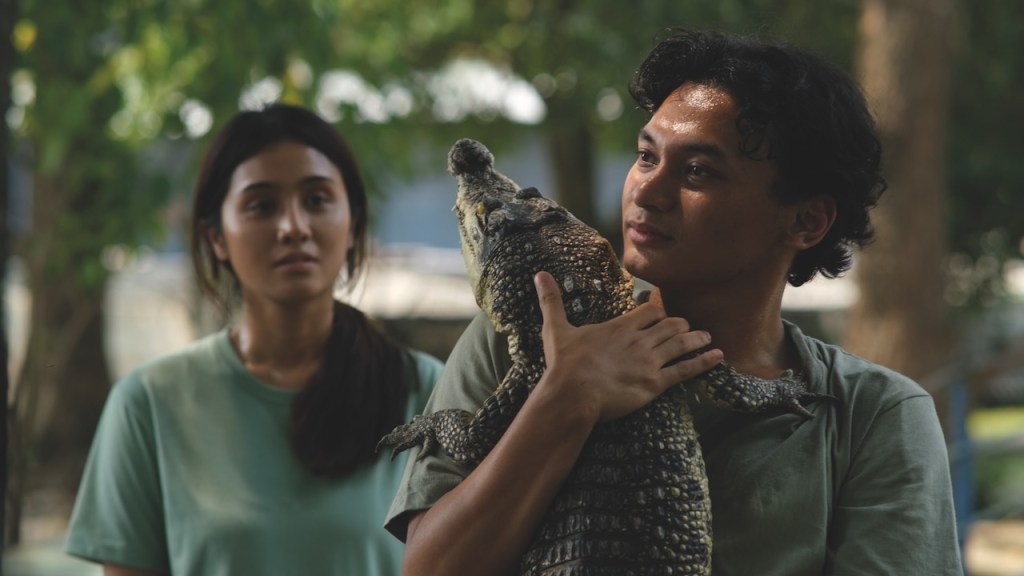
Crocodiles have long been a feature of religion throughout history, and still remain a part of many today. Whether worshipped as gods or considered spiritual ancestors, many cultures have an intriguing mythology surrounding them. One that first-time director, Tumpal Tampubolon touches on in his feature debut, Crocodile Tears.
Set on a crocodile park in West Java, Indonesia his film follows a mother (Marissa Anita) and son (Yusuf Mahardika) who live and work together on the reptilian reserve. Johan and “Mama” share a particularly close bond, but once Johan meets and becomes taken with the new girl in town, Arumi (Zulfa Maharani), it looks like it will only be so long before his mother might snap.
The scaly setting that Crocodile Tears unfolds in immediately gives its story a sinister sense of foreboding. Yet, despite living in such close proximity to so many pearly-white-teethed predators, it quickly becomes apparent that Johan is most at risk from the overbearing actions of his own flesh and blood.
One part coming-of-age drama, one part psychological thriller, Crocodile Tears refuses to be restricted to any single genre. However, it’s most interesting when exploring the mysterious connection between Mama and the large albino crocodile that they have isolated from the other crocs on the park. Through this relationship Tampubolon dives into the film’s main themes of grief, motherhood and loneliness – illuminating the reason for Mama’s unorthodox behaviour towards her son.
Marissa Anita does well to demonstrate Mama’s paranoia, while Yusuf Mahardika succeeds at conveying Johan’s difficulty of remaining loyal to his mother while also trying to make a new life for himself with Arumi. The trio of central performances work best when all the relationships have been established and Tampubolon starts to play with the dynamics of the characters. Although, not long enough is spent in this pivotal phase of dramatic tension before things already start to wrap up for the finale.
This lack of confidence in allowing his screenplay to breathe is one of a few indications of Tampubolon’s inexperience, the other being some amateurish examples of cinematography during a number of exterior shots. Although, with Crocodile Tears brimming with interesting ideas and striking imagery it’s easy to forgive these immaturities in ability.
As while a lack of focus and perhaps one too many ideas – its reluctance to commit to just one genre stops it from excelling in any – hold it back, Crocodile Tears remains a compelling watch throughout and delivers an original and unusual mama’s boy story that’s worth basking in.
Star Rating: ★ ★ ★
 Not Too Loud
Leave a comment