Directed by: Brad Peyton
Written by: Leo Sardarian and Aron Eli Coleite
Run Time: 2 hours
If you were shown only a quick glimpse of Jennifer Lopez’s new CGI-drenched film Atlas, you could be forgiven for thinking that you were actually watching her similarly effects-heavy film musical/fever dream This Is Me… Now: A Love Story (2024). Yet, despite their strikingly similar aesthetic, Atlas is in fact a completely different project – Lopez’s second with Netflix after The Mother (2023) – and her third this year following documentary The Greatest Love Story Never Told (2024).
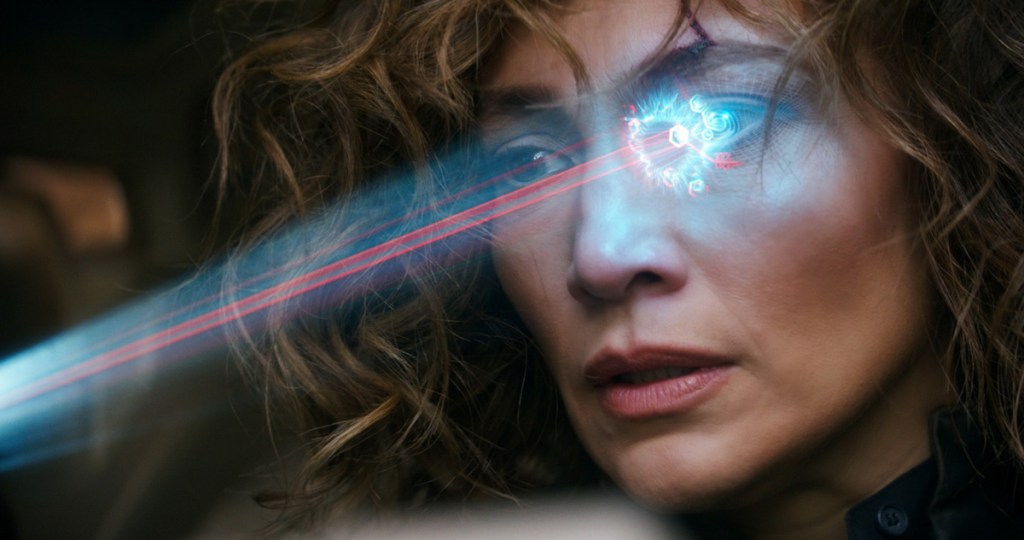
Atlas is set in a near future where AI has successfully been embedded in everyday life. However, this peace is abruptly disturbed when an “AI terrorist” known as Harlan (Simu Liu) sparks a rebellion that claims the lives of three million humans. Escaping to another planet Harlan remains at large for 28 years until analyst Atlas Shepherd (Jennifer Lopez) discovers his location and joins the mission to bring him in.
With the film’s plot existing on an interplanetary scale a certain level of VFX is to be expected, however Atlas is overindulgent to the point of self-sabotage. There is actually a lot of skilled VFX work on display here, yet the film’s excessive use of CGI creates an incredibly unattractive landscape for the film’s action and story. The visuals lack any quality of authenticity, as without any tangible details the overall image becomes dull and textureless.
Unfortunately, for the most part, the same can be said of the performances too. Simu Liu plays the villainous AI terrorist and his performance is about as one-note as they come. Admittedly, he is portraying a robot, but still, he plays it all a little too safe. At least Abraham Popoola, who stars as a fellow AI baddie attempts to have slightly more fun with a similar role. Elsewhere, Mark Strong and Sterling K. Brown appear, albeit in fairly disposable roles. They are predictably reliable, but don’t really get a chance to contribute anything overly memorable – perhaps for them, a blessing in disguise?
Ultimately, it’s a Lopez vehicle through and through (note also her producer credit) and she does a serviceable job. The issue is she’s better than the script she’s working with. This juxtaposition of standard means that at times Lopez’s performance feels over the top. The cliched screenplay makes it rather difficult to take anything, including her performance, particularly seriously despite her earnest efforts.
In addition to this the majority of the film sees her occupying the screen by herself, with only the voice of another AI, Smith (Gregory James Cohan), for company. This doesn’t make for the most engaging of dialogue as the pair’s initially fractious relationship gradually develops into something more meaningful in painfully predictable fashion.
With this in mind there’s certainly no need of an atlas to locate the main source of the film’s problems, as in fact most of the issues stem directly from the screenplay. And while it’s easy to label modern sci-fi flicks that centre around the topic of AI as unoriginal, there are simply just so many classics (and a number of more recent titles for that matter) that have already offered more interesting, thoughtful and exciting explorations of the subject: 2001: A Space Odyssey (1968), Blade Runner (1982) and The Terminator (1984) to name just a few. But making a film about AI now compared to decades past should not be the same, the context is wildly different.
With AI now posing a very real threat to the livelihoods of all kinds of artists, its increased use in films – Late Night With the Devil (2023) and Netflix’s own true-crime documentary What Jennifer Did (2024) have both been caught amidst AI controversy – and it being one of the major issues of contention in the 2023 writers/actors strike, it seems like a truly bizarre choice, then, to make a film with such a pro-AI message at its core, yet here we are. It could possibly be excused if Atlas had anything of remote interest to say about AI, but when the crux of the message is “not all AI is bad” it doesn’t feel insightful enough to warrant listening to.
For some, the few admittedly well-executed action sequences may be enough to distract from the lack of intelligence beyond the artificial. Director Brad Peyton certainly has some talent for shooting action, threatening at times to make Atlas a viable option for some mindless fun. But paired with such ill-conceived writing it never quite manages to achieve this. As with its recycled narrative and imprudent morals the old adage that Hollywood is all out of new ideas – or at least where Atlas is concerned, good ones – has never felt more relevant.
Star Rating: ★ ★


 Not Too Loud
Leave a comment