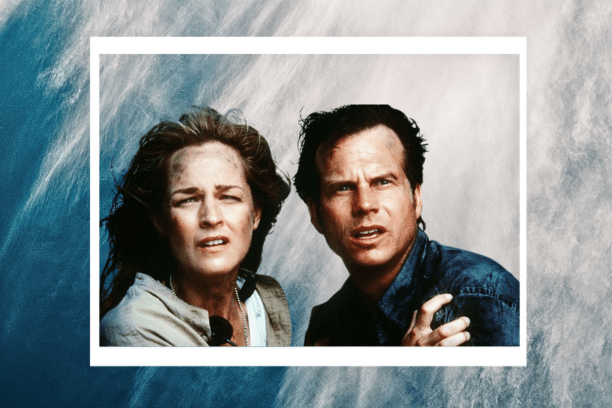
Ahead of Lee Isaac Chung’s upcoming standalone sequel, Twisters, Hamish Calvert looks back to Jan de Bont’s original disaster thriller Twister (1996), to see how well it has weathered since its release.
After putting Keanu Reeves and Sandra Bullock through their paces on an explosive bus in debut film Speed (1994), dutch director Jan de Bont set his sights on sending Bill Paxton and Helen Hunt into a spin for his sophomore effort, Twister. As the title suggests, his second film sees his two leads come face-to-face with some seriously extreme weather. But, almost thirty years later, how does the film hold up?
Filmed on location in Oklahoma and later Iowa, the setting for Twister comes alive with ease. Taking advantage of the real roads, cornfields and local residential areas, it boasts an authenticity that has become somewhat of a rarity in modern blockbusters. The genuine quality of shooting on location helps to ground Twister alongside the computer-generated imagery (CGI) used to create the all-important tornadoes that the film revolves around, or should that be that revolve around the film?
“…it boasts an authenticity that has become somewhat of rarity in modern blockbusters.”
At the time of the film’s release the effects used to create these natural weather phenomenons earned Twister an Oscar nomination. De Bont’s film ended up losing out to Roland Emmerich’s Independence Day (1996), but Twister did pick up the BAFTA equivalent. This attention from awards bodies certainly feels warranted as even by today’s standards the effects are passable.
Of course some aging is to be expected, although this is more noticeable in the contents that the tornadoes carry, rather than the weather formations themselves. Rogue tree trunks and floating livestock are the elements of poorer quality. However, looking back at these more aged examples of CGI, they can easily be excused thanks to De Bont’s thorough use of practical effects throughout the rest of his film.
It’s no surprise that after his high-speed debut, De Bont is very comfortable directing vehicular action. And considering the storm-chasing concept at the heart of Twister this features heavily throughout the film, looking great at each and every turn. He gives the chases excellent energy and with real debris hitting the cars he creates a tangible atmosphere for actors and audiences alike.
For one scene tractors were literally dropped from helicopters to create the illusion of them falling from the tornado, while elsewhere jet engines were used to simulate the extreme winds. This attention to detail is a consistent feature throughout the film and it’s because of it that Twister has been able to stand the test of time.
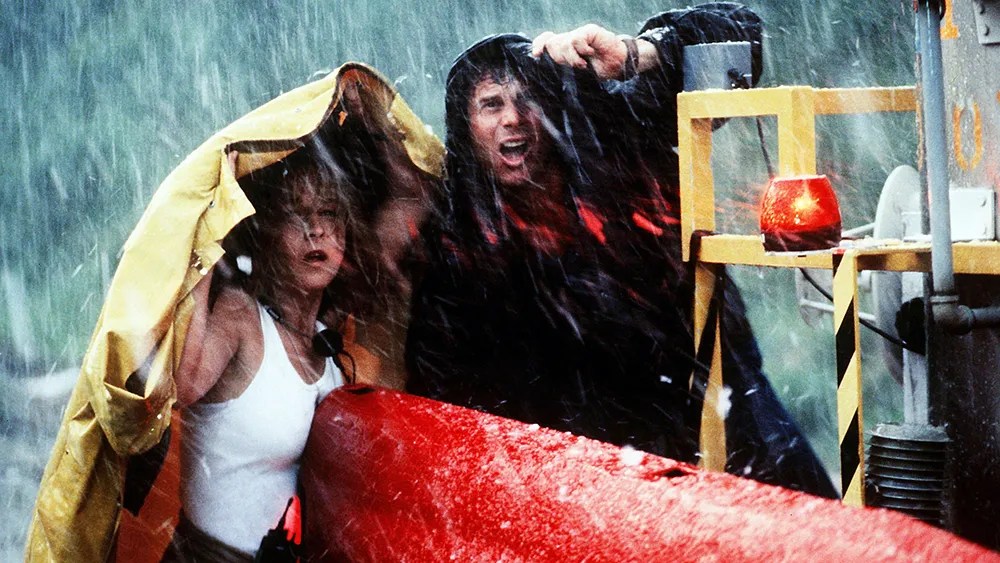
In an interview with Vulture De Bont detailed the full extent of his practical effects. “For instance, there’s a scene in the car near the end when Helen and Bill [Paxton] get into a hailstorm. And you have to understand that the hailstorm is a real hailstorm: We had two gigantic trucks with huge wind machines spitting out ice cubes at the actors.” Some might view this commitment to achieving such realistic visual effects as a small sacrifice to make for the art of great filmmaking. Yet on the other hand it could also be easily considered beyond the call of duty.
It’s true that the shoot for Twister was infamously turbulent and often at the expense of the cast and crew too. Paxton and Hunt were temporarily blinded by 16,000 watt lamps, cinematographer Jack N. Green was hospitalised due to an on-set injury and De Bont had a reportedly stormy demeanour on set including allegedly pushing over a crew member for missing a cue. “It was rigorous. And Jan de Bont – there’s a reason his movies look so cool,” Hunt later recalled in another interview by Vulture.
“This attention to detail is a consistent feature throughout the film and it’s because of it that Twister has been able to stand the test of time.”
Nonetheless, both Paxton and Hunt have also spoken favourably about the director and the work they did together. Their efforts were certainly not in vain either as Twister went on to become the second highest-grossing film of 1996 with $495,700,000 at the worldwide box office – once again finding itself runner-up to Independence Day which topped the chart that year. Perhaps if Lee Isaac Chung’s sequel is more successful than the disappointing Independence Day: Resurgence (2016) Twister might just have the last laugh.
Nevertheless, while the success of the original can certainly be accredited to the special effects used to generate the film’s formidable forces of nature, it’s actually the superb practical effects used that have ensured it remains an exciting watch today. Many modern blockbusters could learn a lot from Twister and numerous other titles like it from this era. A strong foundation of practical effects is only ever going to enhance the quality of any special effects being used.
But maybe the more important lesson to learn is to, yes, absolutely strive for the most realistic practical effects possible, but obviously never at the expense of the cast and crew’s well-being.
 Not Too Loud
Leave a comment